How much water is actually in your aquarium?
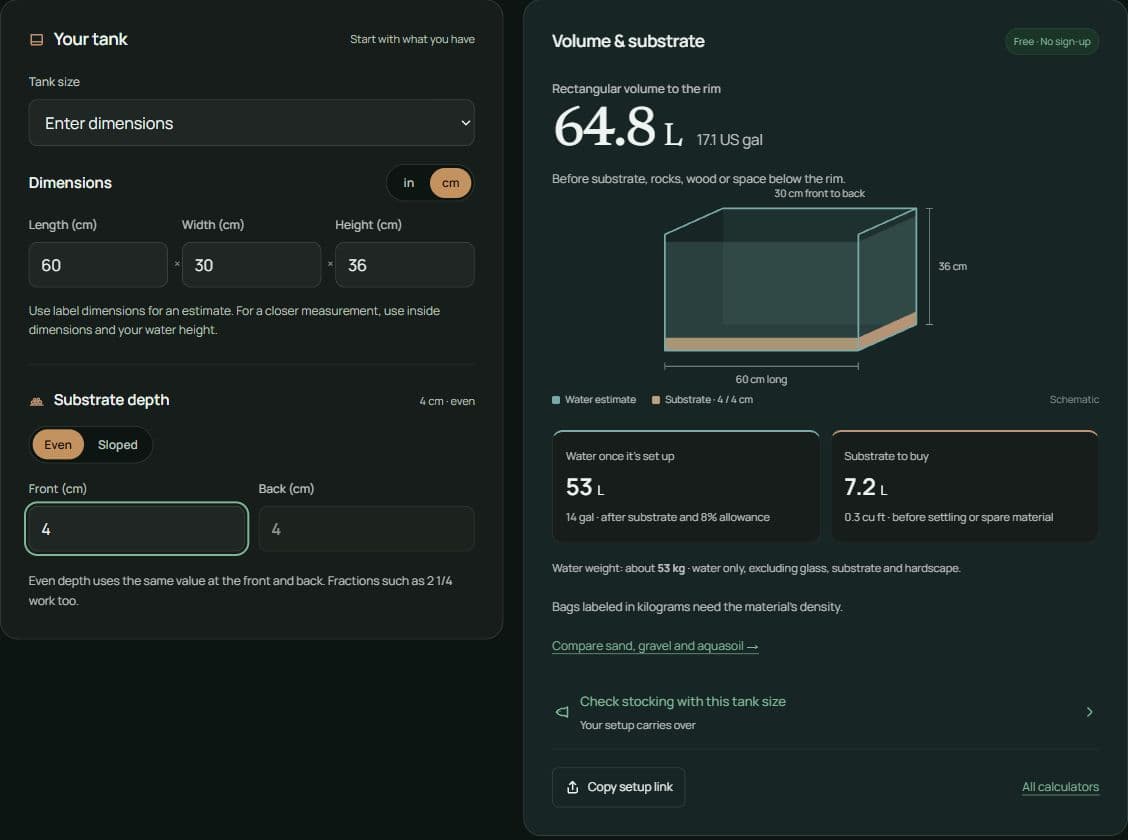
Scapesome’s current volume calculator with a 60 × 30 × 36 cm example and a 4 cm bed. The displayed 53 L is a planning estimate, not a measured fill.
A tank can have three perfectly reasonable volume figures: the size on the box, the volume calculated from its dimensions, and the water you actually put in it. Trouble starts when you use one figure as if it were another.
Before buying materials, an estimate is useful. Once the aquarium is built, you can measure the fill. Keep both numbers, with a note saying what each includes.
Start with the space inside the glass
For a rectangular aquarium, length × width × height in centimeters, divided by 1,000, gives liters. Use all three measurements in the same unit. A US liquid gallon is about 3.785 liters; an Imperial gallon is a different unit.
An empty rectangular space measuring 60 × 30 × 36 cm has a geometric volume of 64.8 L. That calculation says nothing about the eventual waterline or what you will put inside.
For a closer aquarium water volume estimate, measure inside the glass and measure height up to your intended waterline. If you use external dimensions or the full height to the rim, label that calculation accordingly. Do not quietly mix an inside length with an outside width.
The size printed on a tank is also a product designation. Check the manufacturer’s actual dimensions rather than expecting a nominal gallon label and a calculation to match exactly.
What a substrate calculation leaves out
In the 60 × 30 cm example, a flat 4 cm bed occupies a geometric envelope of 7.2 L: 60 × 30 × 4 ÷ 1,000. Subtracting that envelope from 64.8 L leaves 57.6 L.
That is still not a measurement of the water. Water enters spaces between grains; solid rocks, wood and equipment displace some of it elsewhere. A branch with gaps between its limbs does not displace its entire bounding box. A deep bed is not one solid block either.
This is why subtracting a few tidy volumes can look more precise than the available information warrants. The arithmetic can be exact while the assumptions remain approximate.
If your immediate task is buying the bed, use the aquarium substrate calculator. Its geometric bed volume answers a purchasing question. It does not measure the solid fraction of the material after filling.
Read the calculator’s allowance before using its answer
Scapesome’s aquarium volume calculator subtracts the modeled substrate volume from the rectangular volume, then applies an 8% allowance for hardscape and space below the rim.
For the example above, the calculation is 57.6 × 0.92 = 52.992 L, displayed as 53 L. The screenshot shows those same inputs and result.
The 8% is a planning allowance. It is not a measured property of your rocks, a promise that every aquarium loses that proportion, or a glass-thickness correction. A sparse layout and a large rock pile will not necessarily have the same difference between estimated and measured aquarium water volume.
Use label dimensions when you want a quick first comparison. For a closer check, use internal dimensions and your intended water height, then remember that the calculator still applies its allowance. Do not manually subtract the same rock estimate twice and call the result more accurate.
Measure the fill when the setup exists
For a new build, record the water you add using a container with known markings or a suitable water meter. Keep the final waterline consistent. If you are measuring the whole circulating system, account for water in the filter, hoses or sump separately from water in the display.
A useful note might read: “Display filled to this mark; 49 L added in measured containers; filter water recorded separately.” That is much easier to interpret later than a lone number labeled “tank size.” Container markings and meters have their own uncertainty, so avoid claiming laboratory precision.
You cannot recover a precise historic fill by subtracting a photograph’s apparent rock volume. For an established tank, keep estimates labeled as estimates and measure what you can during normal maintenance.
Use volume for the question it can answer
Aquarium water volume helps you compare planned setups and interpret changes in the amount of water present. It does not describe the length of an open swimming route, territorial boundaries or whether a particular fish suits the aquarium.
After checking the number, review the actual footprint, livestock needs and obstructions. The stocking calculator is a further planning check, not a reason to squeeze more animals into a smaller measured fill.
Keep the dimensions, the estimate and the measured fill beside each other. Then, when a result looks different from the number on the box, you can see which assumption changed instead of trying to make every figure agree.