20 gallon long vs high: which tank fits your plan?
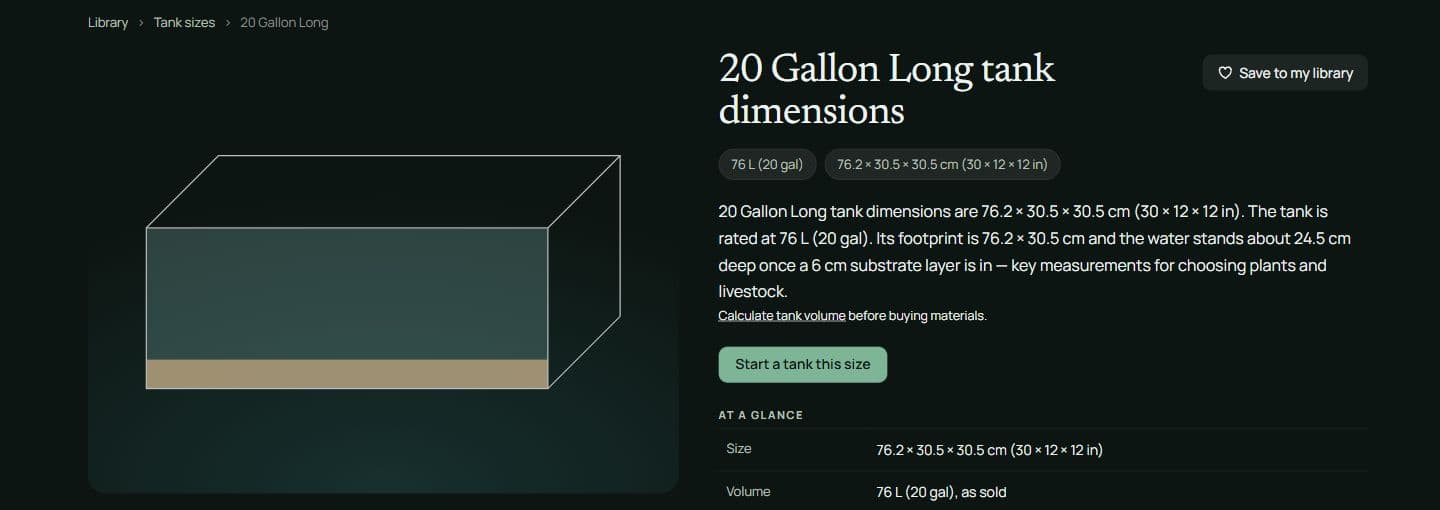
The 20 Gallon Long entry in Scapesome’s tank library. Its rounded planning preset is 30 × 12 × 12 in; check the exact manufacturer’s dimensions before buying a tank, stand or lid.
Put a long tank and a high tank beside each other and the shared “20 gallon” label stops being very helpful. One gives you more room from left to right. The other fits into a shorter space and gives plants more room above the substrate.
If you already know where the tank must stand, start there. If the location is flexible, sketch the hardscape and planting footprint before choosing the glass.
Compare dimensions on the same basis
In Aqueon’s published sizing sheet, the 20 Long measures 30¼ × 12½ × 12¾ in, while the 20 High measures 24¼ × 12½ × 16¾ in. These are manufacturer dimensions, including the frame, rather than clear internal planting space.
Dimension | 20 Long in that sizing sheet | 20 High in that sizing sheet |
|---|---|---|
Length | 30¼ in | 24¼ in |
Front-to-back width | 12½ in | 12½ in |
Height | 12¾ in | 16¾ in |
Outside length × width | About 378 sq in | About 303 sq in |
The long model has six more inches of length; the high model has four more inches of height. Their front-to-back width is the same. The outside footprint is about 25% larger on the long model, calculated from these dimensions. That percentage is a comparison of rectangles, not a measurement of usable substrate area.
Scapesome’s 20 Gallon Long and 20 Gallon High entries use rounded planning presets. Those are useful for comparing proportions. They are not a substitute for the current specification of the exact model in your shopping basket.
What the longer base changes
When comparing a 20 gallon long vs high for a low planted layout, the longer base is often the more useful difference. It lets you separate a planted group from an open area without asking both to occupy the same short stretch of glass.
Imagine a wood group taking up 10 inches along the tank. On a simplified 30-inch plan, that leaves 20 inches along that axis; on a 24-inch plan, it leaves 14. This is only a drawing exercise—wood is irregular and equipment takes space—but it makes the tradeoff visible before you buy it.
The extra base also needs more substrate at the same depth. Using the outside footprints above as a rough comparison, an even 2-inch bed has geometric volumes of about 12.4 L and 9.9 L respectively. Use actual internal dimensions for your order and allow for the bed shape. Equal gallon labels do not imply equal substrate requirements.
A longer route may be relevant to the fish you are considering, but six extra inches do not automatically make a species suitable. Check adult size, group needs, behavior and water conditions separately. This comparison is not a stocking list.
What the taller shape changes
The high model gives you more vertical room for upright wood and taller planting within a shorter length. That can be helpful when a long tank simply will not fit the intended position.
Subtract your substrate depth and space above the waterline before deciding how much height is available. A tall tank with a raised rear bed has less space for background plants than its outside height suggests. A low tank with long leaves may develop a surface canopy unless you choose a smaller plant or maintain it differently.
Extra height is not the same as extra depth from front to back. If the problem is that a bulky rock leaves no room behind it, the 20 High in this comparison does not solve that problem: both models have the same listed width.
Also check your reach. Measure from the finished stand height to the bottom of the aquarium, and leave room above it to remove a lid and use your tools. A tank that fits a wall recess can still be awkward to plant or clean.
Make the choice from your actual constraints
Choose the long shape when the horizontal layout is the priority and you have an appropriately sized stand and location. Choose the high shape when a shorter length is essential or vertical planting is central to the plan. Confirm that your proposed animals suit the chosen dimensions either way.
Before ordering, check the exact tank footprint, the stand’s support and load requirements, and the matching lid and light fit. A stand intended for one “20 gallon” model does not become compatible with another just because the label matches.
For the 20 gallon long vs high decision, the most useful quick exercise is to mark both footprints at full size on paper. Place outlines of the major rocks and wood inside each, then leave space for planting and access. If one version only works when you ignore the filter or press every object against the glass, you have found the compromise early.
Once you have chosen dimensions, use the volume calculator to compare the bed and water estimate. Keep the layout guide alongside it for the next decision: where the materials should go.