Anubias nana vs Petite: which fits your hardscape?
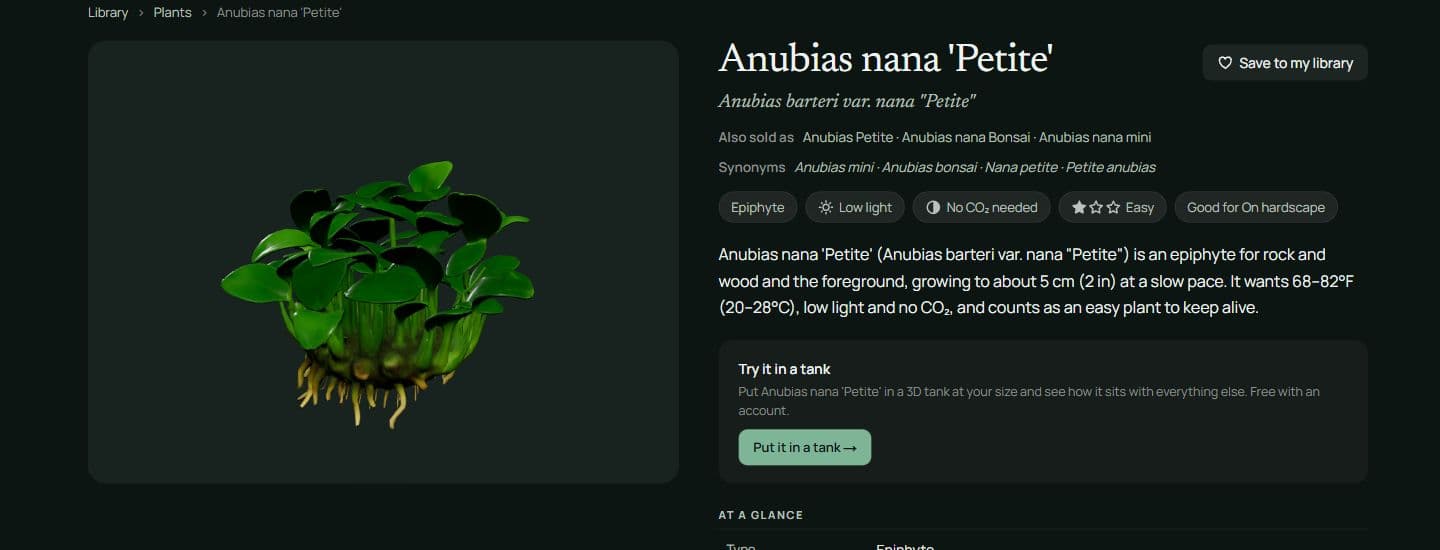
The Petite entry in Scapesome’s plant library, using an existing catalog model preview. It is an appearance reference, not a photograph of a measured specimen.
A small plant can still hide the detail you bought a piece of wood for. With Anubias, the choice is often less about keeping the plant alive and more about how much of the branch, rock face or gap you want to see after it fills out.
Ordinary nana and Petite can both belong in a modest planted tank. You do not have to choose one variety for the entire aquarium. Choose a position first, then decide which leaf scale suits it.
Petite is smaller, but it still spreads
Petite is a compact cultivated form with smaller leaves. Tropica’s description puts its low foliage around 3–5 cm, while the standard nana description gives roughly 5–10 cm; the same supplier’s height tables use open-ended ranges. Treat these as guides to relative scale, not guaranteed final dimensions for every plant sold under those names.
Low height also does not mean a tiny footprint forever. Both grow along a rhizome—the horizontal stem from which leaves and roots emerge. A short plant can form a broader patch as that stem branches and extends.
When buying Anubias nana 'Petite', inspect the actual portion and its label. A seller’s photograph, a tissue-culture cup and a mature plant attached to wood can show very different amounts of plant. Do not compare their apparent coverage as though each were one equivalent pot.
The Petite entry and standard nana entry let you inspect both in the same library. Read the supplier’s description of the stock you will actually receive as well.
Match the leaf scale to what should remain visible
Use Petite when a larger leaf would obscure a narrow branch junction, a small stone edge or a gap that matters to the composition. It can soften an attachment point without making that point the largest green object in the scene.
Ordinary nana is worth considering when you want a more substantial leaf group against a broader rock or a thick wood base. Covering some of the material may be the purpose there. Smaller leaves are not automatically a better choice simply because the aquarium is small.
Try this before buying: look at the intended position from the usual viewing distance, then mark the boundary that must remain visible. Is it the end of a branch? A dark opening? The line between two stones? Judge the plant against that boundary rather than against the empty tank.
A group on the front face of a rock will interrupt its outline differently from the same group tucked beside or behind it. Moving the attachment position can solve the problem without changing variety or adding more plants.
Attachment height adds to plant height
Suppose a branch sits 14 cm above the substrate and you are allowing roughly 5 cm for a low leaf group. The top of that group would sit around 19 cm above the substrate before accounting for leaf angle and spread. That is an illustrative envelope, not a growth prediction.
Now compare it with the waterline and with the leaves behind it. “Only five centimeters tall” can still be too prominent when the plant starts high on the hardscape.
When inspecting the layout, look from the front and from above. The front view reveals blocked outlines; the top view reveals how much horizontal space the group occupies. A digital preview can help compare placement, but a catalog model cannot certify the exact leaf size of your purchased plant.
Give either variety the right kind of position
Both are slow-growing rhizome plants suited to attachment on rock or wood. Keep the rhizome exposed rather than burying it under substrate. Fine roots and the rhizome are different parts: roots reaching into the bed do not mean the horizontal stem should be covered.
They can be useful in comparatively shaded positions, but a dark crevice with almost no light is not the same as a lightly shaded area. Do not place the leaves under a dense overhang and assume an “easy” label removes the need for suitable conditions.
Avoid using slow growth as a promise that nothing will change. Leave access to inspect the attachment and remove damaged leaves. If the visual gap matters, plan to maintain the group rather than expecting it to stay at its sale size indefinitely.
A simple way to make the final choice
Choose Anubias nana 'Petite' for a position where a smaller leaf group helps preserve fine hardscape detail. Choose ordinary nana where a broader group is welcome and there is room for it. If both work, compare the actual portions, price and amount of coverage you want now.
You can also leave the most detailed part of a rock bare and plant beside it. A layout does not need every join concealed. The aquarium layout guide is a useful next step if the plant choice keeps changing because the hardscape’s focal point is still undecided.