Which background aquarium plants will fit your tank?
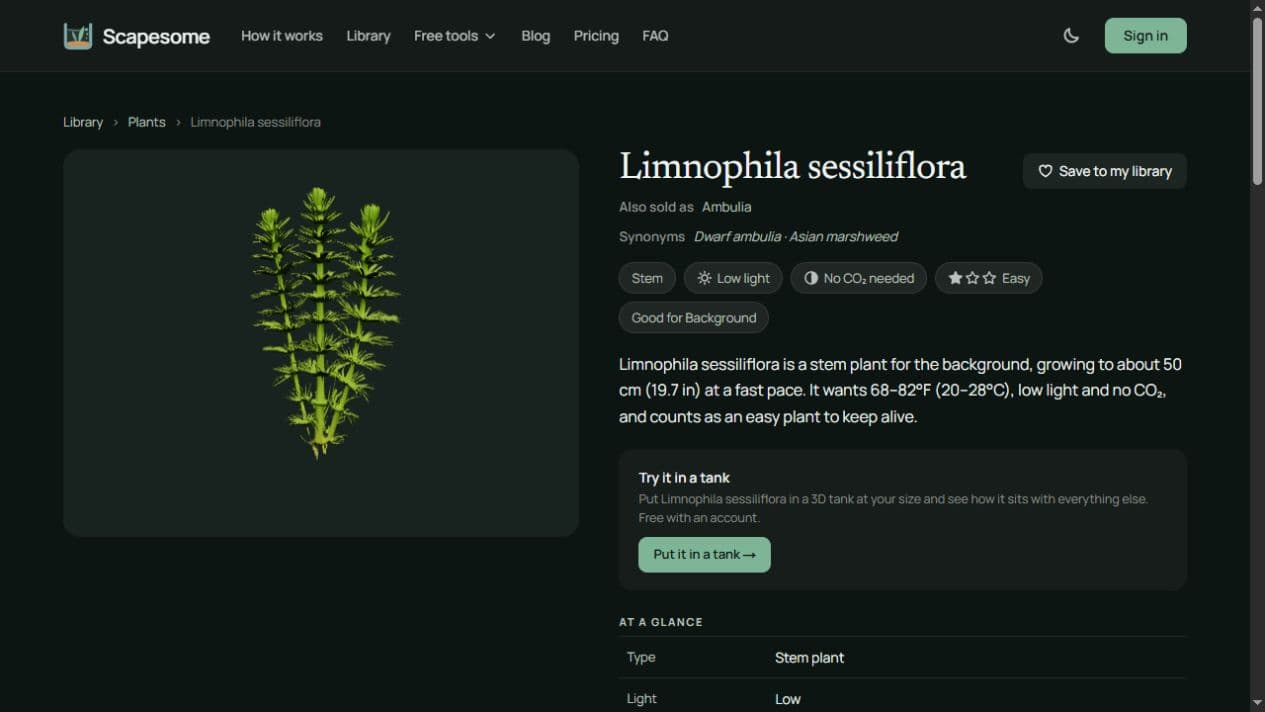
Limnophila sessiliflora in Scapesome’s existing plant library. The catalog model illustrates its fine-leaved form; it does not predict how a purchased bunch will grow in your aquarium.
A background plant is only in the background while it stays behind the rest of the layout. Long leaves can reach across the surface. A bush can widen over the foreground. A few small shoots can eventually hide the wood that was meant to be the focal point.
Choose background aquarium plants by the space they can occupy and the maintenance you are willing to do. Color is a useful final choice, after those two questions have an answer.
Measure from the bed to the waterline
Use the top of the substrate where the plant will grow, not the bottom of the glass. In a tank with 36 cm of internal height, a waterline 2 cm below the top and a rear bed 8 cm deep leave 26 cm above that bed. This is a planning example, not a recommended bed depth.
If the same bed is raised to 12 cm, the available height becomes 22 cm. You have changed the plant’s space without changing the tank label. A high rear slope and a tall background group both use the same vertical room.
Check the plant’s growth description, not only a single height in a table. An open-ended “30+ cm” range does not mean growth stops at 30 cm. A long flexible leaf can bend across the surface instead of standing upright above its base.
For your shortlist, write down three things: the space above the bed, the width of the planted group, and the part of the hardscape that must remain visible. These are more useful than calling the back third of every aquarium a “background zone.”
Choose the kind of background you want to maintain
There are several ways to fill that space. The following examples illustrate different decisions rather than a ranking of the best plants.
Fine foliage: Limnophila sessiliflora
Limnophila sessiliflora offers fine, divided foliage in a group of upright stems. The grower describes rapid growth up to about 40 cm and notes that poor light can produce leggy growth.
Consider it when you want a soft-looking green group and can keep up with its reach. Reserve access to trim it; do not put it in the darkest gap behind a tall stone and expect the fine foliage to disguise unsuitable conditions.
A shaped bush: Rotala rotundifolia
Rotala rotundifolia forms side shoots and can become bushy. Keeping light available to the lower leaves is part of maintaining that group. Its color depends on growing conditions, so a red photograph should not be your only reason to choose it.
Consider this form when you want to maintain an outline with pruning. Before buying, decide where that outline ends. If a planted bush must stay within a narrow gap between wood and glass, leave enough working space to reach it.
Broader upright leaves: Bacopa caroliniana
Bacopa caroliniana gives a different texture from fine, feathery stems. Its grower describes stems with leaves spanning roughly 3–4 cm and a relatively slow growth rate compared with many other stem plants.
That can suit a plan where you want a more deliberate upright group. It still needs space for side shoots and suitable conditions. “Slower” does not mean you can ignore the final height or squeeze the bases into one tight planting hole.
A ribbon curtain: a named Vallisneria
Vallisneria offers long strap-like leaves and spreads by runners. Check the named species or cultivar. For example, the supplier’s description of V. spiralis ‘Tiger’ gives leaves around 30–50 cm long; that is a claim about that cultivar, not a size rule for every Vallisneria sold.
Choose a ribbon curtain if you want its flowing outline and can manage the spread of leaves and new plants. If the plan depends on an unobstructed surface above a light-demanding foreground, long leaves sweeping across it may be the wrong tradeoff.
Check conditions where the leaves will actually be
The back of the aquarium is not automatically a brighter place because it is nearer the light fitting on a drawing. Wood, tall rocks, floating plants and the fixture’s coverage affect that location.
Match the named plant to your light, CO₂ provision, nutrition and water conditions before relying on a growth example. Changing only the plant label will not repair a deeply shaded pocket. Equally, do not buy extra equipment solely to reproduce the color of an unidentified online photograph.
The plant library is a useful place to inspect forms and start a shortlist. Check the exact supplier’s stock description as well, especially when the same trade name covers different cultivars or growing forms.
Leave a route for future trimming
A group that fits on day one can still be difficult to maintain. Leave room to get scissors behind it and to lift out trimmings without dragging them through delicate foreground plants. Keep necessary access to intakes and other equipment.
For a small first layout, choosing one background form can make that job easier than interleaving several fast-spreading plants. This is an editing choice for the layout, not a biological limit on species count. Add another form because it has a distinct role, not because the back glass looks temporarily bare.
Before finalizing background aquarium plants, return to the front view and ask what should still be visible once the group has filled out. If the answer is the main branch, an open channel or a patch of light, draw the plant boundary around that decision. The layout guide can help resolve the focal point before you fill the remaining space.