A 10-gallon aquascape that leaves room to work
A stone can fit a 10-gallon tank and still leave nowhere to put your hand. The dimension I would ask a seller for first is the stone's front-to-back depth in the position you plan to use. Here is what happened when I changed that one dimension in a 10-gallon plan.
Same stone shape, 10 centimeters more depth
I opened the 10-gallon tank preset and placed one Dragon Stone model in the middle depth zone. Its displayed size was 12 cm long, 12 cm high and 8 cm deep. I kept the stone's position, length, height and camera view, and changed the model depth to 18 cm.
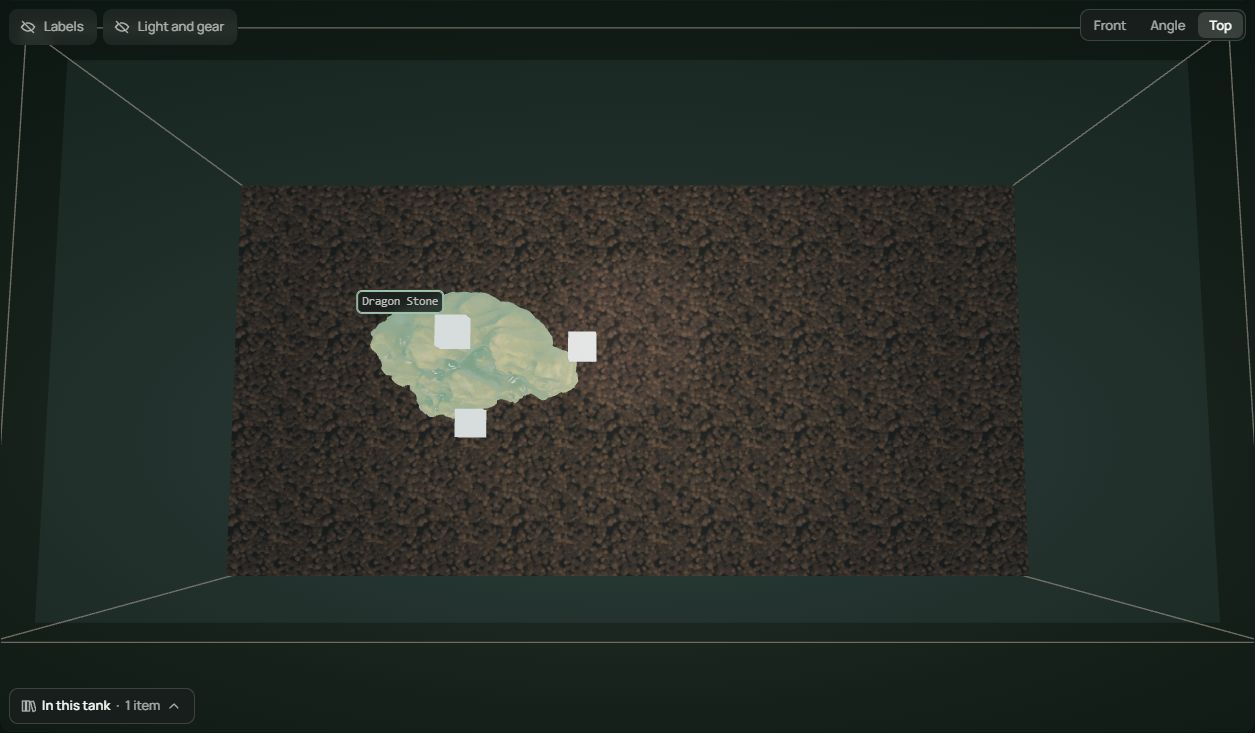
8 cm deep. There is space around the modeled stone on both sides. The white handles show that the stone is selected.
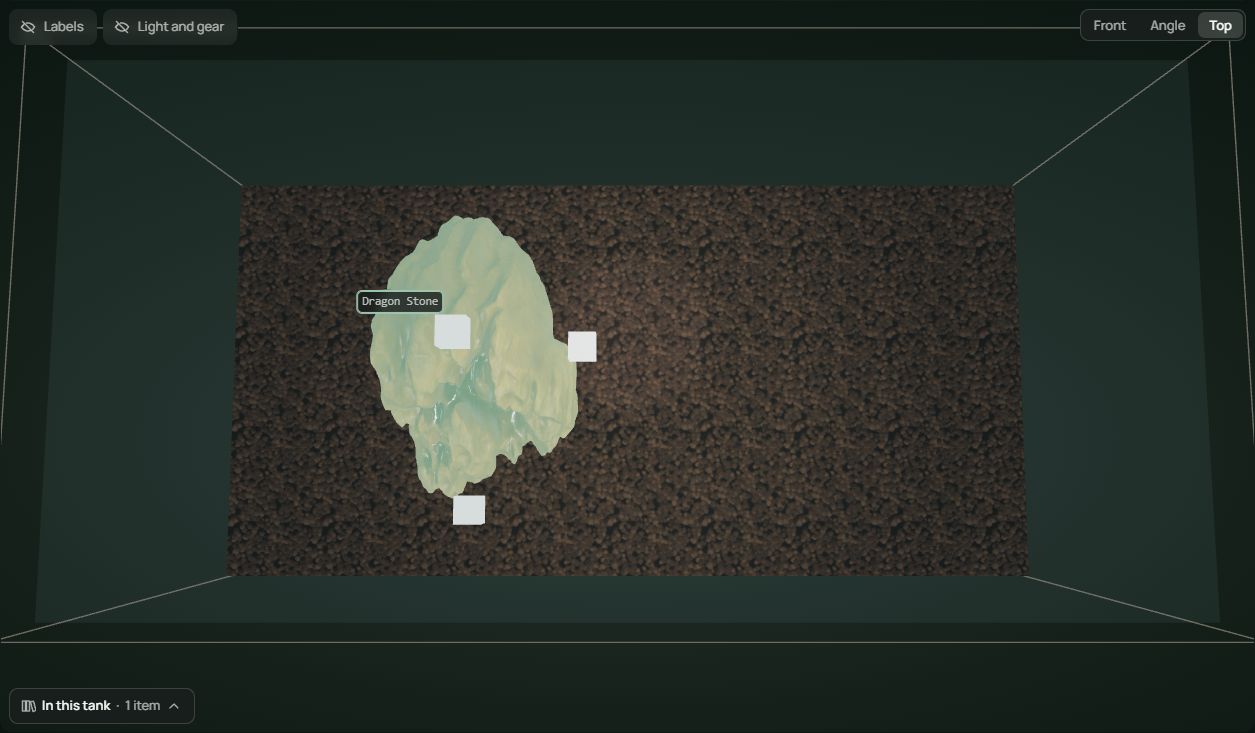
18 cm deep. The stone reaches much farther toward the front and back. Both images show a Scapesome model, not two pieces measured in a filled aquarium.
The 10-gallon preset is about 25.4 cm deep. In that rectangle, an 8 cm bounding box leaves 17.4 cm of front-to-back space in total. An 18 cm box leaves 7.4 cm. If a box were centered, that would be about 8.7 cm or 3.7 cm per side respectively. These are envelope calculations. An irregular stone can be narrower at one end and wider at another, and your tank's inside depth can be smaller than the preset.
The larger shape also leaves a generous patch on the right. That open patch may be great for a low plant group, but it doesn't make the narrow strip beside the stone easier to reach. Check the route to the place you will actually clean.
Choose what the open space is for
If you want an open foreground, set your scraper head against the front pane on a paper footprint. Leave the width it needs along its whole route, then place the stone outline behind it. A cardboard outline cut to the size of the real piece gives you more information than a photograph without a ruler.
If you want a planted back corner, set the pot or a paper outline of it behind the stone. Make sure you can insert the tweezers from above and lift them out without moving the hardscape. With a hood or an internal filter, test the real opening too. There can be room around a plant at the bottom while the tool handle catches at the top.
For a wood-led layout, draw the base and the projecting branches separately. A base that clears the scraper may still have a branch that blocks the handle. The driftwood size guide explains which measurements to request when a listing only gives the longest dimension.
What to write down before ordering
Take three numbers to the shop: your inside depth, the largest depth you can give the hardscape, and the narrowest clearance your own tool needs along its path. Ask which orientation the seller measured. If the answer leaves room only when you assume the rock is perfectly centered, try a shallower piece first.
This comparison is a fit check before purchase. It doesn't test how a real stone sits on the substrate, the stability of a stack, or the water conditions a particular piece produces. Use the hardscape check before gluing once the pieces are in hand.