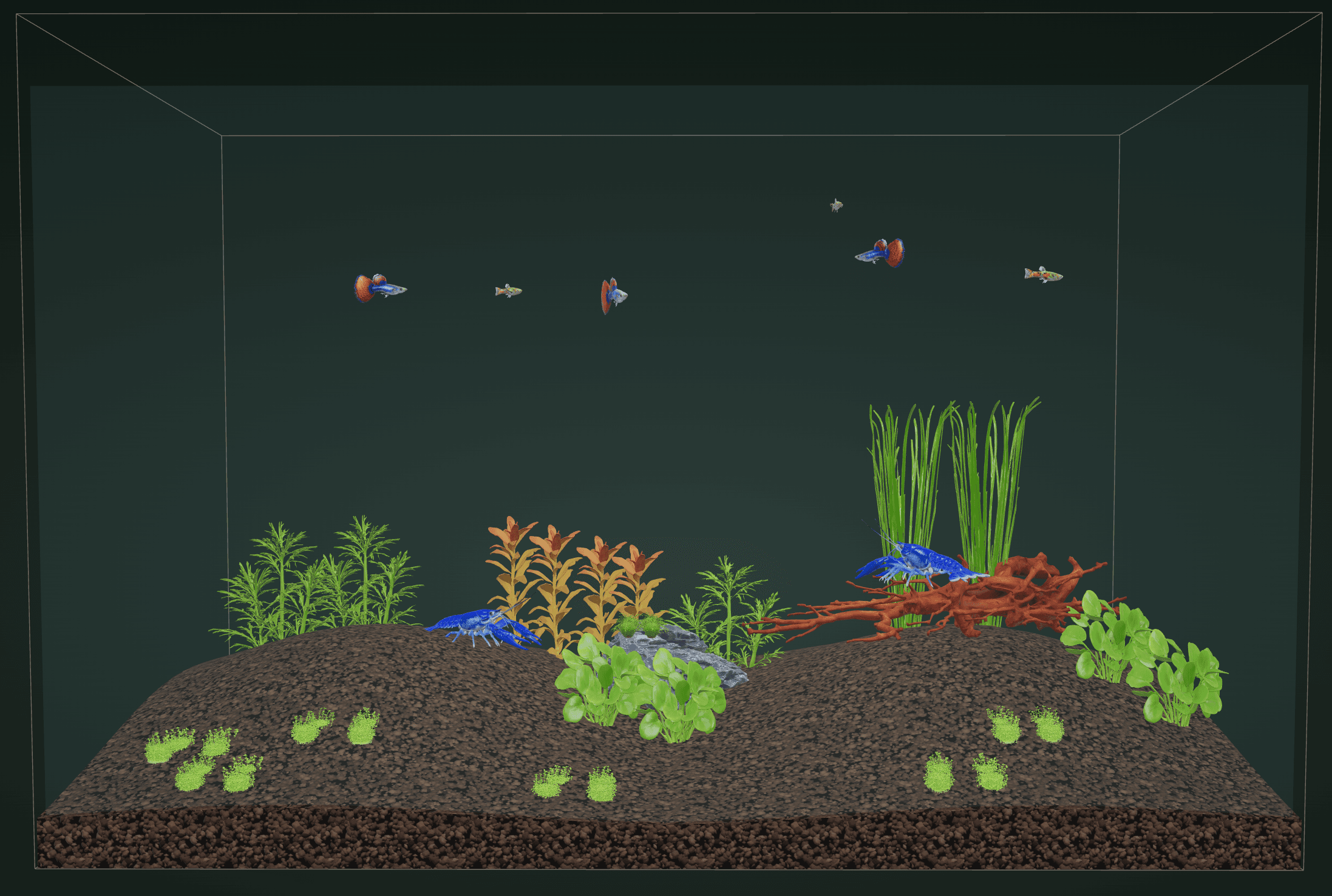
Aquascaping styles: which will you enjoy maintaining?
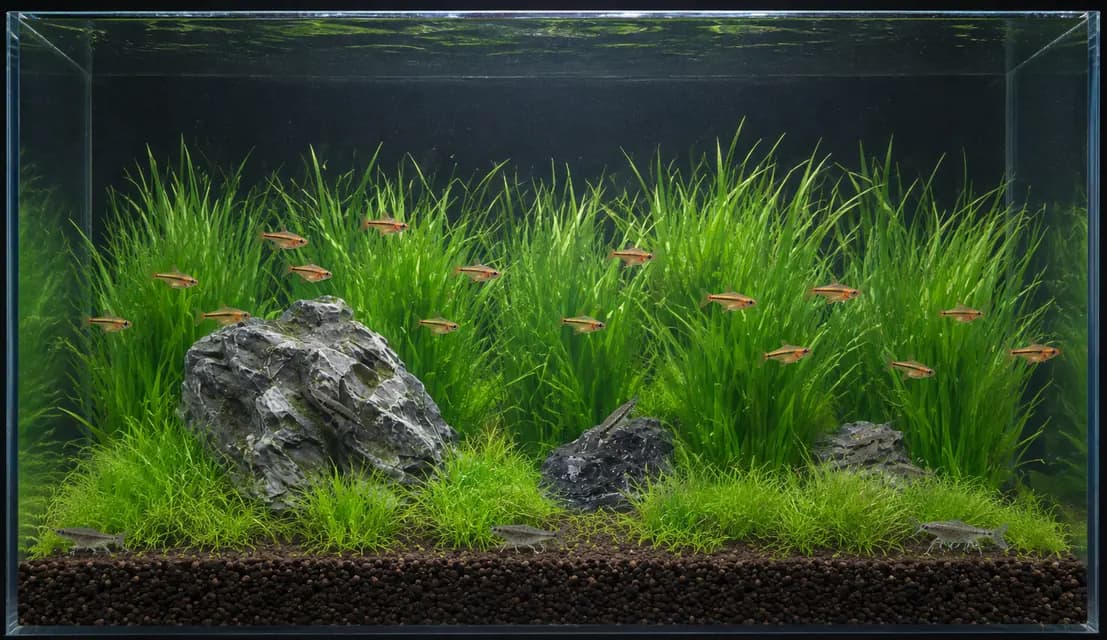
Grassy Stones, an existing Scapesome preview from a layout placed by hand. This is a product visualization, not an aquarium photograph, a maintenance trial or a formal style standard.
Save a few aquarium photographs and a pattern usually emerges. Perhaps you keep choosing exposed stones, or loose wood with leaves around it, or a tank packed with sharply separated plant groups. Those preferences are useful. The next question is what keeps each of those pictures looking that way.
You do not need to enter a contest or follow a style perfectly. Understanding the main aquascaping styles helps you choose which features to borrow, what to buy and which maintenance jobs will come with them.
Iwagumi: let the stones remain visible
Iwagumi centers the composition on stone arrangement. The shape, angle and relationship of the stones do much of the visual work. A restrained plant palette often leaves that structure easy to read.
Sparse-looking does not necessarily mean little work. When stones are the focus, algae on their faces is conspicuous. Low planting can need regular trimming to keep the contours exposed and prevent a thick mat from lifting away from the bed.
Before committing, choose the actual plants and check their light and CO₂ needs. The style name does not require you to buy a demanding carpet, but a photograph of one is not proof that it will work with your setup. A carpet without CO₂ injection needs its own realistic planting choice.
Try this decision: would you still like the arrangement if the stones were surrounded by a less uniform planting? If yes, you have room to adapt the look. If only an immaculate lawn will satisfy you, price and plan the growing conditions and care that lawn needs.
Nature Aquarium: build around a relationship of materials
Nature Aquarium layouts use plants, wood and stones to create a coherent impression of nature. They need not depict a literal miniature landscape. Some rely heavily on wood; Iwagumi also sits within the wider Nature Aquarium tradition, so the labels are not completely separate boxes.
For a home tank, the useful choice is the main structure. Does a wood branch lead the eye into an open space? Do plants soften its base without hiding its shape? Can you keep that open space as the planting expands?
Allow access around the piece. Moss and attached plants can change the outline substantially, while stems behind the wood may need trimming or replanting. A striking front view can conceal a corner you cannot reach.
This approach gives you freedom to combine growth forms, but it still depends on matching their requirements. A natural-looking mix is not automatically a compatible mix.
Dutch style: make the plant groups do the work
Dutch aquariums emphasize contrasting groups of plants: differences in leaf form, color, height and texture create depth and focal points. Clearly shaped groups matter more than a display of large exposed wood or rock.
That is not the same as filling every spare gap with another species. Too many small groups can make the arrangement hard to read and harder to maintain. Traditional contest guidance has detailed conventions; a home aquarium can borrow the contrast and grouping without claiming to follow every rule.
Expect gardening. As groups grow into each other, their boundaries and relative heights change. Some stems will need cutting and eventual replanting. If choosing, trimming and reshaping plants is the part of the hobby you enjoy, that work may be an attraction.
If you mostly want to watch fish after work, ask whether you want that amount of shaping. A less formal planted arrangement may preserve the colors you like with fewer boundaries to keep crisp.
A loose planted or jungle look
“Jungle” is used loosely in shops and hobby discussions. It usually suggests dense, overlapping growth with less emphasis on clearly clipped groups. Treat it as a visual description rather than a fixed recipe or a guarantee of low maintenance.
Plants still shade each other, runners still spread, and a dense tank still needs accessible equipment and appropriate swimming space. A broad-leaved specimen that fits the look can close a feeding area or dominate a small tank.
Choose what you are willing to let overlap. Keep deliberate access gaps even if they are hidden from the main viewing angle. You can enjoy an abundant appearance without giving every plant unlimited space.
Choose aquascaping styles by the work they need
Write one sentence about what you want to preserve: “visible stone ridges,” “one branching piece with an open foreground,” or “contrasting plant groups.” Then list the jobs that keep that feature visible. This is more actionable than buying a product bundle labelled with a style.
Compare those jobs with your equipment, available space and appetite for maintenance. Pick plants for the actual conditions, then arrange the materials. The layout planning guide takes that choice through to a buying plan.
Scapesome lets you place the materials and plants by hand to review the arrangement. Use that preview to check shape and access; judge the real pieces for safety and stability before installation. You can borrow a style's visual idea while building a tank you will still enjoy after the photograph.