Carpet plants without CO2: which ones suit your tank?
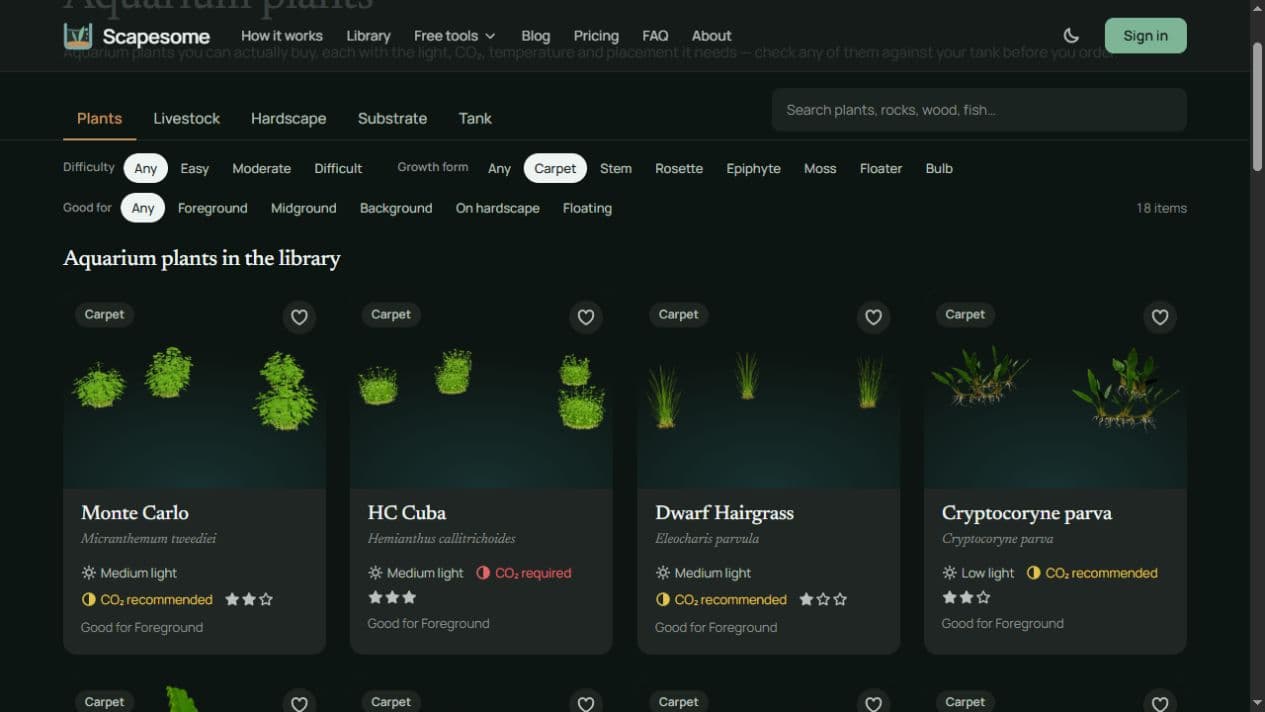
Scapesome’s plant library with Carpet selected. The cards include plants with different CO2 requirements.
You want green across the front of the tank, but you do not want a cylinder, regulator and diffuser. The awkward part is shopping: a pot labelled ‘foreground’ can become a loose meadow, a little patch of rosettes or a close-cropped lawn. Those are different results, even when all three plants stay alive.
The useful question is which result you would be happy to keep. This guide compares three options for a freshwater tank without CO2 injection, then works through a smaller planted area you can plan before buying. The aim is to leave you with a plant and a planting area that make sense together.
Start with the foreground you actually want
Here, ‘without CO2’ means without injecting it. Aquatic plants still need carbon. A low CO2 requirement is useful when making a shortlist; it does not promise a dense, flat carpet under any lamp.
Small leaves between open patches: consider Marsilea hirsuta. Allow for changes in leaf shape and height after planting.
A grassy foreground: consider Helanthium tenellum ‘Green’. Leave room for visible blades rather than expecting a millimetre-short lawn.
Low, separate groups: consider Cryptocoryne parva. Its slow growth makes it a poor choice for filling a large empty floor quickly.
This is a shortlist for three different looks, not a ranking of every carpeting species. If the tank has a shaded front corner, deal with that corner before choosing a plant. A plant being short does not make the spot bright enough for it.
Three plants, with different reasons to choose them
Marsilea hirsuta: small leaves, with some flexibility
Marsilea hirsuta is a sensible place to start if you like a small-leaved foreground and can accept variation. Tropica rates its light and CO2 demands as low. The clover-like leaves in a new pot may give way to single or divided leaves after the plant adjusts underwater; the growing conditions affect the form it takes.
That makes it a more forgiving design choice when the composition can accommodate a slightly taller or less uniform patch. Avoid planning a rock ledge that only looks right if every leaf remains at one exact height. Check the scientific name on the pot, too: a shop selling ‘Marsilea’ has not necessarily identified the same species.
Helanthium tenellum ‘Green’: choose it for a meadow
If you want blades rather than round leaves, look at Helanthium tenellum ‘Green’. Tropica describes this cultivar as a runner-forming foreground plant with low light and CO2 demands. Its description gives a carpet height of roughly 5–10 cm with good light and a nutritious bottom layer; its separate plant-info height range is broader. Treat those figures as context, not a guaranteed finished height in your tank.
The attraction is the grassy texture. The cost is space in front of the rocks. In a shallow scape, a few centimetres of foliage can hide a low stone you meant to keep visible. Verify that the seller means the ‘Green’ cultivar: the more reddish form of H. tenellum is not the same visual choice.
Cryptocoryne parva: small groups, and a long wait
Cryptocoryne parva suits a foreground made of deliberate little groups. Its slow growth is the reason to choose a modest area rather than expecting a few pots to race across the tank. Tropica rates its CO2 demand as low but its light demand as medium, and specifically warns against other plants overshadowing it.
That is the catch if you associate crypts with shade. Keep this one out from under a large leaf canopy or an overhanging piece of wood. Choose it because you like the low rosette form and can live with gaps for a while, rather than because ‘smallest crypt’ sounds like ‘quickest carpet’.
Check the light at the bottom, not just the plant label
Before ordering, look down through the tank at the exact area you want planted. Where does wood cast a shadow? Will the background stems lean over it? Will floating plants cover it? A clear strip at the front is a different planting site from the dark recess beside a rock.
There is no single lighting recipe behind every successful non-injected carpet. David Pierce’s 35 L display, published by Tropica as Layout 115, includes Marsilea hirsuta and Helanthium tenellum ‘Green’. It lists no CO2 injection, aquarium soil and a Twinstar 450e at 40% intensity. The lesson is that those plants have been used in that complete setup; 40% on a different fixture does not reproduce the conditions.
The 2Hr Aquarist also documents carpets without injection, including more demanding choices, using a shallow-tank approach with stronger light and careful acclimation. That is another route, with more conditions to manage. Turning a lamp up is not a substitute for choosing a plant that suits the foreground you can maintain.
When looking at a reference photo, try to find the plant name, whether CO2 was injected, the substrate and how long the tank had been growing. If those details are absent, use the photograph to describe the look you like. It cannot tell you what your own setup will produce.
Make the planted area smaller before buying more pots
Consider a tank with a 60 × 30 cm footprint. Its floor area is 1,800 cm². A planted strip 60 cm wide and 10 cm deep is 600 cm²: one third of that footprint, before subtracting any rocks. Those are simple planning dimensions, not a planting-density recommendation.
You could give that strip a grassy texture, or break it into small-leaved patches with open space between them. Either way, the rest of the floor does not have to fill in before the composition makes sense. Decide where the planting ends, which rock faces should stay visible and which areas you want to leave open.
The calculation cannot tell you how many pots to buy. Pot size, tissue-culture portions, usable material and the supplier’s planting guidance all differ. Mark the actual planted area first, then use the seller’s portion and spacing information for that area. Do not order for the full 1,800 cm² if your drawing only calls for 600 cm² of planting.
If you are still arranging the hardscape, the aquarium layout guide helps you settle the main groups and open space first. For the root zone underneath them, check substrate depth and buying quantity. A smaller planted area does not remove the need for an appropriate substrate.
What about Monte Carlo or dwarf hairgrass?
They are possibilities, rather than automatic failures without a cylinder. The 2Hr Aquarist places Monte Carlo and dwarf hairgrass in a more demanding group than Marsilea in its non-injected carpet guide. Its examples depend on the growing conditions and the adjustment after planting.
Keep either on the shortlist if you are willing to work with those conditions and accept uncertainty about coverage. If your priority is a simple first foreground, there is little value in buying a plant solely because its best photograph matches your reference. Pick the compromise you can tolerate: different leaves, taller blades, slower filling or a smaller planted area.
Leave the shop with a choice, not just a plant name
Write down the species or cultivar, the look you are aiming for, the part of the floor it will occupy and anything likely to shade it. Then ask the supplier how the plant has been grown and how to divide and plant the portion they actually sell. A tissue-culture cup and a potted plant are different starting materials.
You can use the aquarium plant library to compare growth forms and stated requirements while making that shortlist. Read survival requirements separately from the conditions needed for a dense carpet; a low-light label alone does not answer the second question.
For small leaves, start with Marsilea hirsuta. For a grassy look with some height, look at Helanthium tenellum ‘Green’. For slow, low groups in an unshaded spot, consider Cryptocoryne parva. If none fits the light or the waiting time you can accept, leave part of the foreground open. The tank can look intentional before every gap turns green.
Related reading
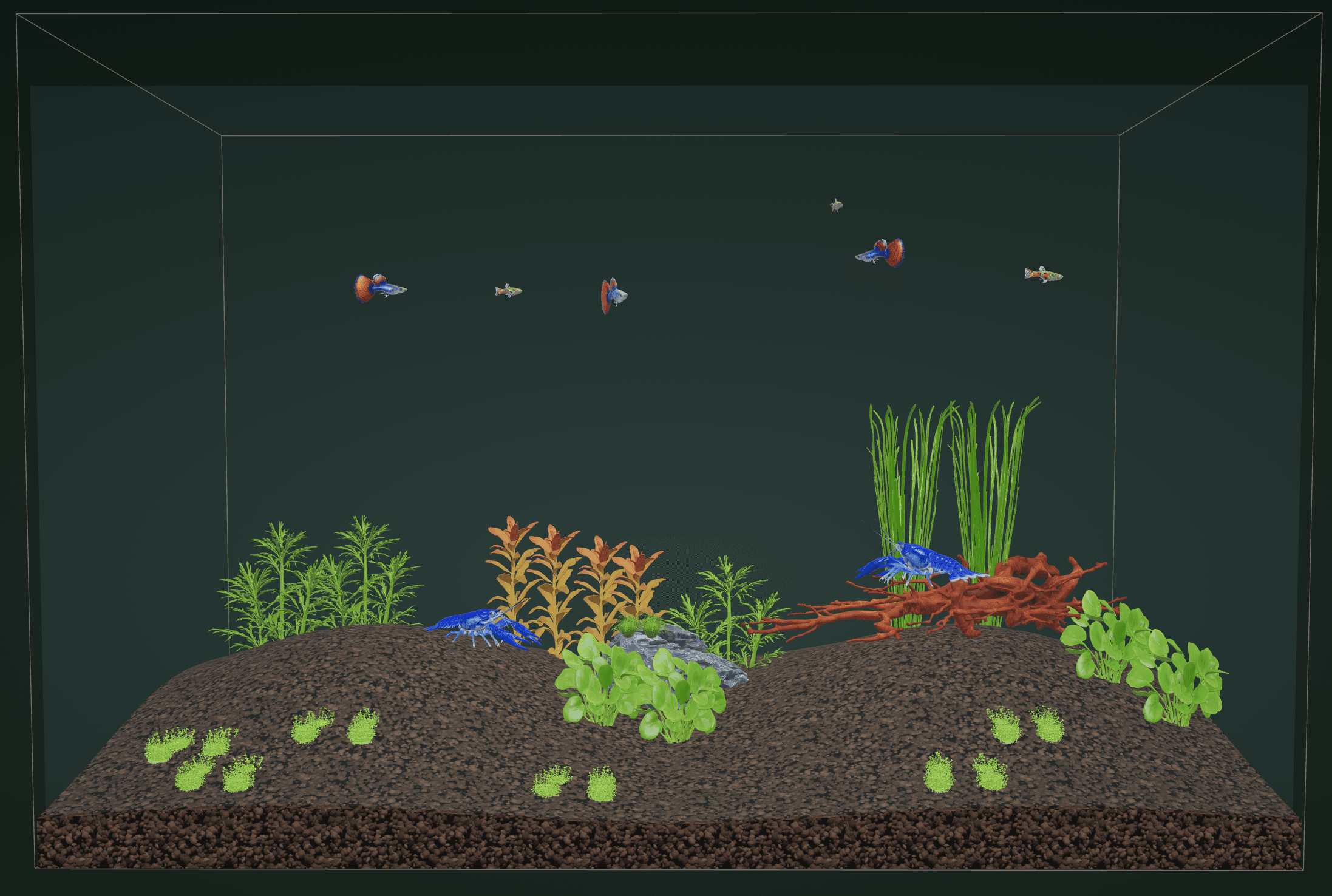
How to plan an aquarium layout before buying rocks and plants
Choose a layout that fits your tank, position the main rock or wood, and plan planting space before buying materials or gluing hardscape.
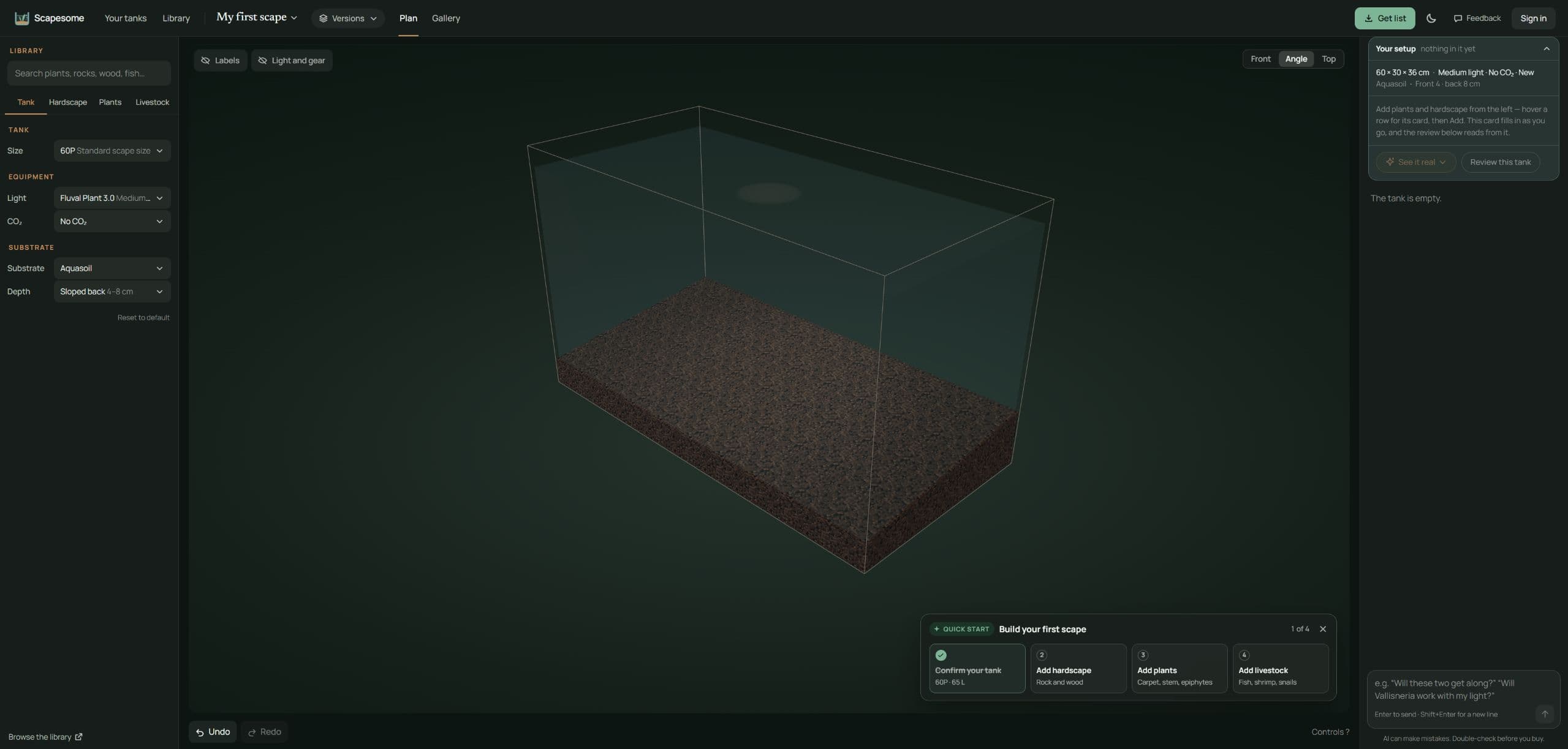
How to choose aquarium substrate depth and work out how much to buy
Choose depth for your material and planting zones, compare flat and sloped beds, and work out the liters and bags you need before buying substrate.