What to check before stocking a planted tank
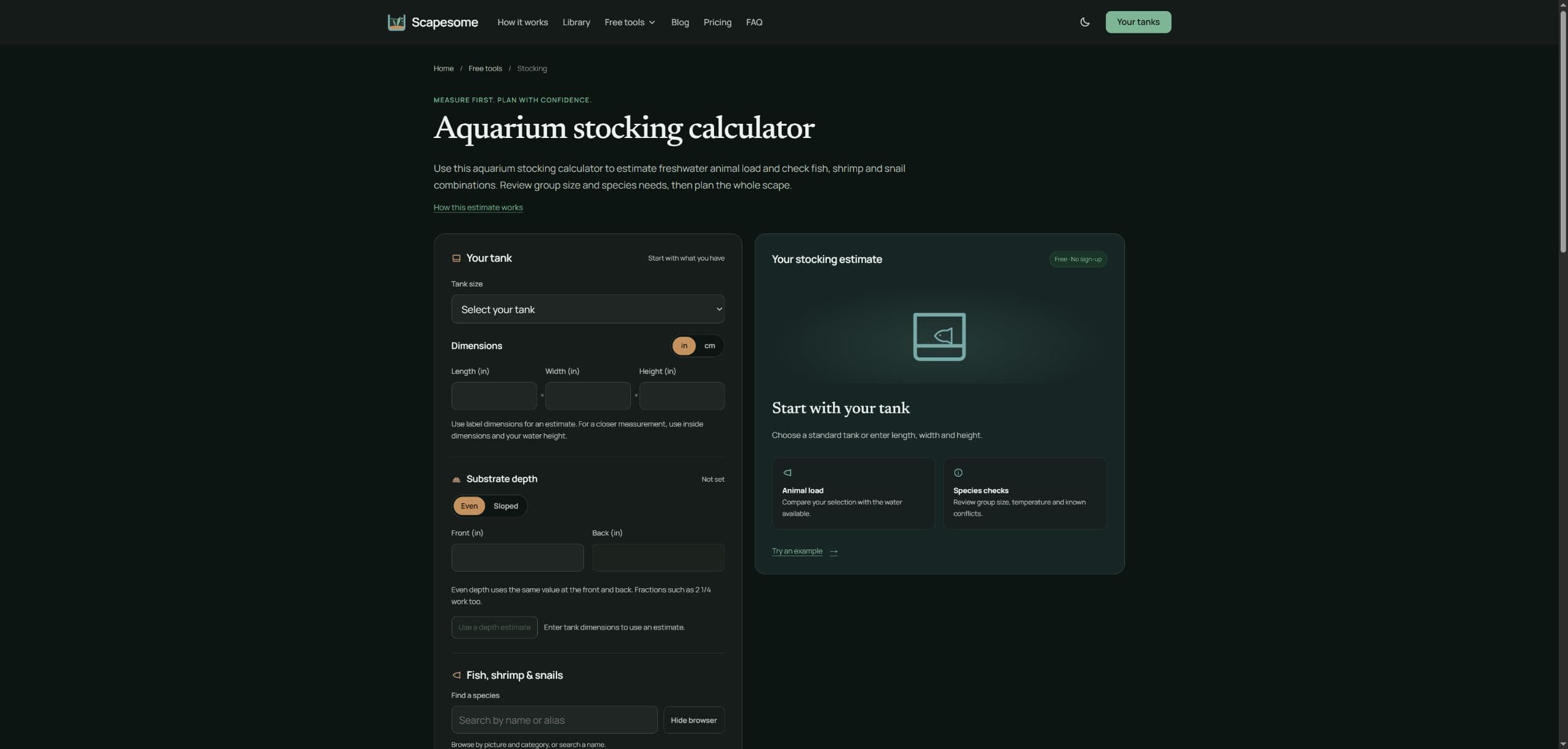
Scapesome’s current stocking tool. Its estimated load and species checks support planning; they do not certify an aquarium as ready for fish.
A planted aquarium can have plenty of leaves and very little usable space for the fish you are considering. Before deciding on a number, check the animals at adult size, their social needs, the water you can maintain and the routes left around your hardscape.
Planted tank stocking starts with a compatible plan, not a target to fill. A volume estimate is useful, but it cannot turn an unsuitable species combination into a suitable one.
Start with the adult animal and its group
The fish at the shop may be juveniles. Check the species’ adult dimensions and expected body shape before deciding that several will fit. A long, active swimmer and a short, deep-bodied fish use space differently even if one length measurement happens to match.
Then check how the species should be kept. For a social species, plan for an appropriate group from the beginning rather than buying one because it is the only number left in a calculation. For territorial fish, investigate space and sex-related behavior instead of assuming that a peaceful-looking juvenile will remain so.
Use the livestock library to make a shortlist, then verify the requirements of each exact species. Common names can be ambiguous. Keep the scientific name with the group and size information so that you know which animal the advice describes.
Look for a workable overlap in conditions
Compare temperature and water requirements across the proposed group. An overlap at the extreme edge of two published ranges is not automatically a sensible long-term target. Also consider the conditions your plants need and the water you can reliably supply.
Do not solve every mismatch by planning more adjustment products. A selection suited to your maintainable conditions is easier to reason about than a list that depends on constantly correcting several conflicting needs.
This step can shorten the shopping list before any arithmetic. That is useful progress: it removes an unsuitable combination while you can still change it on paper.
Trace the space that remains after planting
Look from above as well as from the front. Follow an open route through the intended swimming zone. Is it continuous, or does a large rock divide it into short pockets? Does a branch force fish through one narrow passage? Will a growing plant group close that passage?
Bottom-dwelling species also need usable floor area and suitable substrate. A broad footprint covered almost entirely by rock does not provide the same floor as an open bed. Surface-oriented animals use another part of the tank, which can be affected by floating plants and equipment.
Plants and wood may provide cover and visual separation, but they also occupy space. Do not count every planted volume as equivalent open water, or treat a hiding place as a substitute for the species’ overall tank requirements.
Check the combination, including shrimp and snails
Compatibility is more than matching temperature. Investigate predation, territorial behavior, feeding competition and whether a fish damages or uproots the plants in your plan. A creature marketed as a cleanup animal still has its own needs and contributes to the aquarium’s load.
For example, an apparently small addition may change the plan if it eats young shrimp, needs a group or requires a particular feeding arrangement. An absence of a warning in a database is not proof that every interaction has been tested.
Keep unresolved questions next to the proposed species. Planted tank stocking is easier to revise when the uncertainty is explicit than when a calculator’s reassuring color has replaced the question.
Use the calculator as another check
Enter the proposed selection into the stocking calculator and read the species checks along with the estimated load. Revisit the actual water volume guide if the tank label and the water present are being treated as the same number.
An estimated load is not a certificate that the aquarium can support the selection. It does not establish a mature biological filter, oxygen availability, compatible behavior or an adequate swimming route. A percentage is a reason to inspect assumptions, not a target you must use up.
The readiness to introduce animals is also separate from the final list. Establish and check biological filtration with appropriate water testing; a planted appearance or a fixed number of elapsed days does not demonstrate that the system is ready. Additions need to be managed against the aquarium’s actual condition, not merely the date on a plan.
Your planted tank stocking plan should finish with a species list, appropriate groups, condition overlap, spatial checks and the questions still to resolve. If one fish forces compromises everywhere else, change that choice before changing the whole aquarium around it.
Related reading
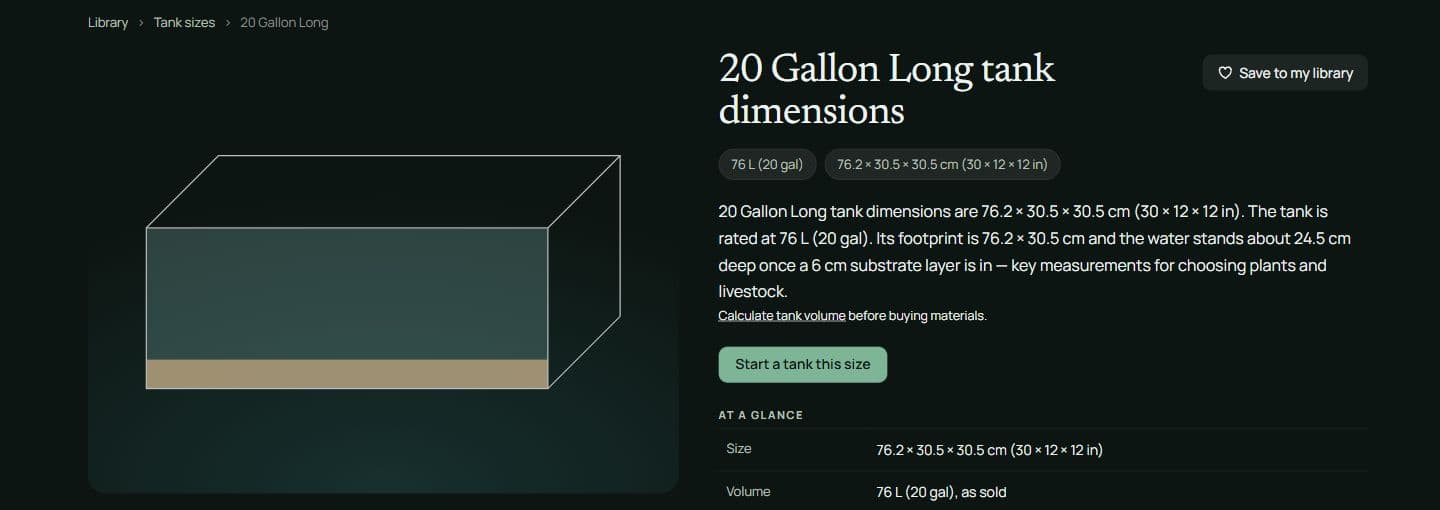
20 gallon long vs high: which tank fits your plan?
Same gallon label, different layout space. Compare length, height, substrate needs and access before choosing your tank.
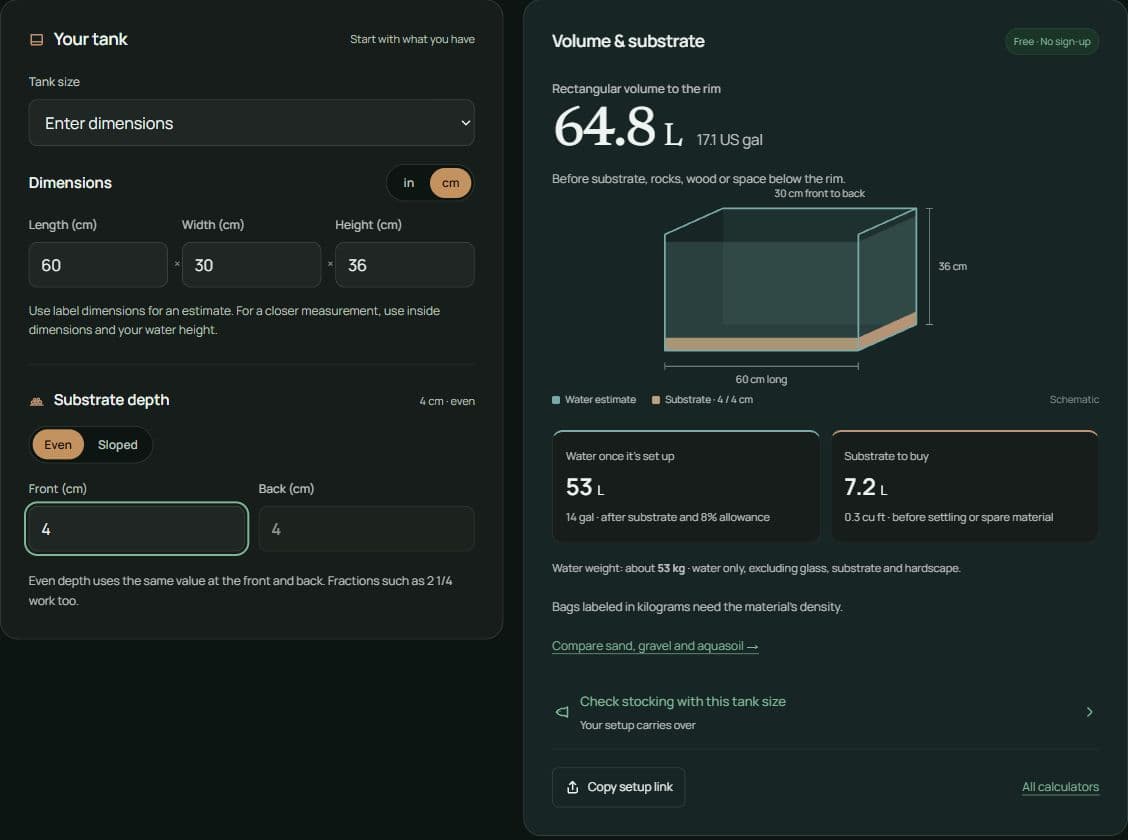
How much water is actually in your aquarium?
Work out which volume figure you need, understand the calculator’s allowance, and record the actual fill once your tank is built.