Aquarium Plant Fertilizer: Choose the Formula, Then Scale the Dose
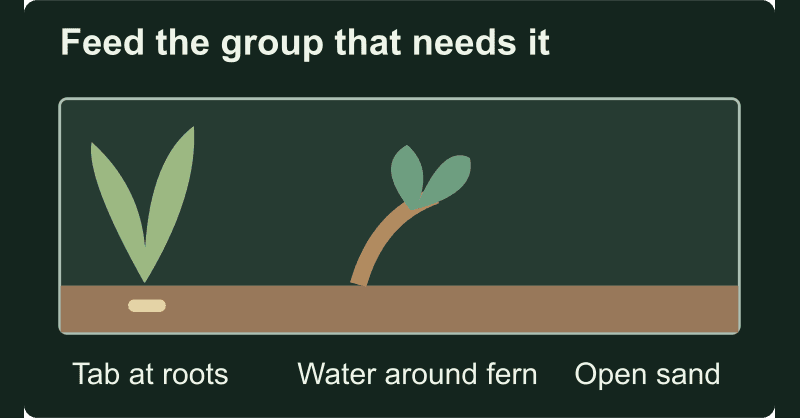
Look at where the plants grow. An Amazon sword planted in plain sand is a sensible candidate for a fertilizer made to go by its roots. A fern tied to wood or a floater at the surface is better reached through the water than by a tab buried across the tank, so a suitable liquid fertilizer is the more direct route if those plants need feeding. A tank can have both kinds of planting. Decide which group needs help before you buy both bottles and tabs.
Divide the tank into feeding zones
Start with the rooted groups. Note what the bottom layer is made of, whether it already contains nutrients and what the substrate maker recommends. In an inert bed, a root tab or capsule labeled for aquarium use can add nutrients near a rooted plant. Check how deeply that particular product should be placed. If the bed is too shallow to keep a tab buried, deal with the bed before trying to tuck a tab against the glass.
Then look at plants attached to wood and plants floating above it. For any liquid fertilizer, check both the nutrients and the dose on the label. Tropica Premium Nutrition and Specialised Nutrition use the same stated weekly starting amount, yet supply different formulations. Choosing between them requires looking at the tank and the label together.
Work through one mixed tank
Picture a sword in the back left, Java fern attached to wood in the middle and open sand on the right. With plain sand, the sword is the first place to consider a buried tab. You don’t need a row of tabs beneath the empty foreground. If the fern and other water-column plants show healthy new growth, there’s no immediate reason to add a second product because the sword got one.
Sketch those three zones before dosing anything. Put the sword’s root area on one line, the attached fern on another, and leave the bare sand unassigned. For each planted zone, record the current substrate or fertilizer and the new growth you want to watch. That makes it easier to choose one change and see whether it helped.
Calculate one label amount from the water estimate
For a worked example, enter a 60 × 30 × 36 cm aquarium and an even 5 cm bed in the aquarium volume calculator. The dimensions give 64.8 L to the rim and the bed occupies 9 L. After the calculator’s 8% allowance for hardscape and space below the rim, the displayed water estimate is 51.3 L.
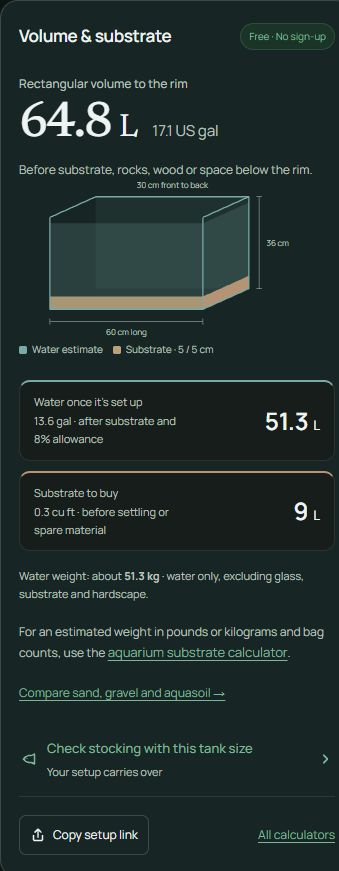
Actual calculator result, captured on November 12, 2026. The 51.3 L figure is an estimated water volume for the label-scaling example below.
Read the dose and volume on the exact bottle. Both Tropica liquids in this example state 6 mL per 50 L weekly.
Scale that label amount to the estimate. 6 × 51.3 ÷ 50 = 6.156 mL, or about 6.2 mL.
Compare with the rim-volume calculation. Using 64.8 L would give about 7.8 mL. Write down which water figure you used so you can repeat the calculation.
This is a label-scaling example for those products. The calculator’s allowance is a planning estimate. Once the aquarium is filled, a measured fill volume gives you a better input. Follow the bottle’s instructions for your plants and conditions, and use a measuring method that can deliver the amount you intend.
Compare the labels before combining products
Official product | Nitrogen and phosphorus | Stated use or placement | Label amount |
|---|---|---|---|
Tropica Premium Nutrition | N 0.0%, P 0.0% in its declaration | Few or slow-growing plants, many fish | 6 mL per 50 L weekly |
Tropica Specialised Nutrition | N 1.3%, P 0.1% in its declaration | Many fast-growing plants | 6 mL per 50 L weekly |
Tropica Nutrition Capsules | Manufacturer lists nitrogen and phosphorus among supplied nutrients | Close to roots of large or strong-rooted plants | Follow the capsule instructions for placement and replacement |
The equal liquid dose can hide the difference between the bottles. Premium supplies iron, magnesium and micronutrients without added nitrogen or phosphorus. Specialised includes nitrogen and phosphorus. The capsule puts nutrients near roots. List what your existing fertilizer and substrate already supply before adding another product. A root capsule and a liquid can share nutrients even though you place them differently. Premium Nutrition · Specialised Nutrition · Nutrition Capsules
Read new growth before reaching for another product
Yellowing, pinholes and slow growth can prompt a closer look, but a single old leaf gives you little to work with. Compare new leaves with older ones, and ask whether the plant is still adjusting after planting. Look for other concrete causes such as a fern rhizome trapped under the substrate, a shaded stem group, or recent changes in light. Correct the placement problem first if you find one.
Keep a brief note of which zone you fed and when. Compare photos from the same angle and look for the next leaves. If the next change is another fertilizer, keep the previous dose, light and timing in view so you can see what you’re adding. For a new inert bed, the planting in sand guide explains how to put the plants in place before choosing a feeding route.
Related reading
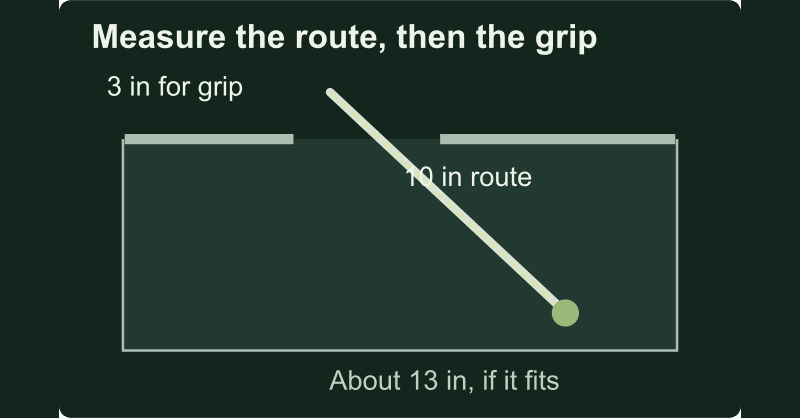
Aquascaping Tools: Check the Reach Before Buying a Kit
Choose tweezers, scissors and a spatula around the jobs in your tank. Compare real tool lengths with your planting route before buying a kit.
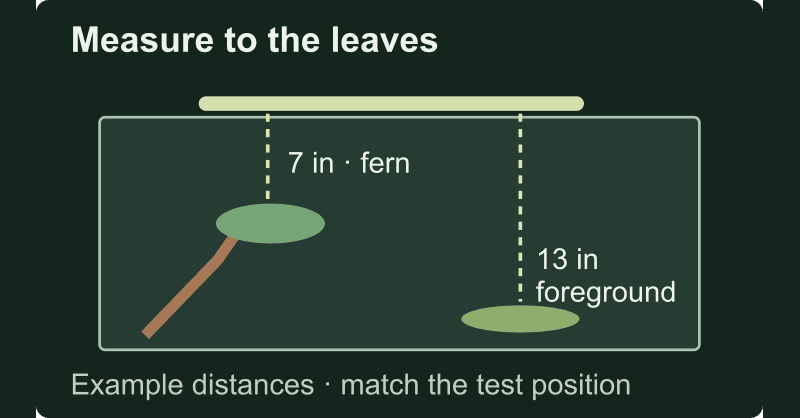
Aquarium Light for Plants: Check the Fit and the Leaf Distance
Measure the mount and fixture-to-leaf distance. Use one manufacturer’s fit and PAR table to decide what to check before buying a planted-tank light.
Dutch Aquascaping: How to Keep the Middle Group Visible
Compare the same three plant groups with the tall stems in two positions. Keep the middle group readable and leave room for the next trim.