Aquascaping Tools: Check the Reach Before Buying a Kit
For a first planted tank, start with tweezers if you’ll plant stems or small plugs. Add scissors when there’s something you’ll need to trim. A substrate spatula earns its place if you’re building a slope or trying to keep a sand path tidy beside a planted bed. The useful kit follows the jobs in your tank, so check those jobs before buying a set.
Your first planting job | Tool to consider first | Check before buying |
|---|---|---|
Small rooted plugs or stems | Tweezers | Tip closure, release and usable reach |
Trimming upright stems | Scissors | A visible cutting tip and room for both blades |
Tidying a narrow sand path | Spatula | Whether its working edge fits the gap |
Attaching plants outside the tank | Try the task by hand first | Whether tweezers improve access to that attachment point |
Take two measurements to the shop
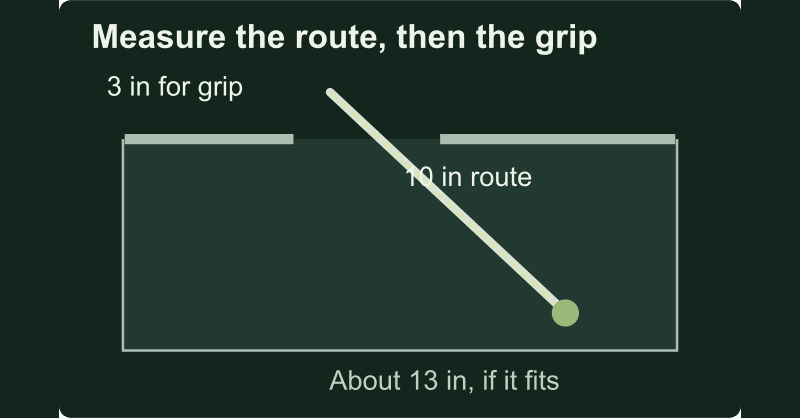
Measure from the top opening to the deepest planting spot. Then measure the narrowest route to that spot with the hardscape and lid in place. A long tool can reach the bottom and still be awkward to turn. Try holding a ruler along the same path, with your fingers where the handle would be. Check whether your hand can stay comfortably above the water where you’re working.
Here is a paper shortlist you can repeat with your own dimensions. Suppose the route from the opening to the planting spot is 20 cm and you want 6 cm left above it for your grip. That gives a screening length of 26 cm. ADA’s Pinsettes Series lists M at 21 cm, L at 27 cm and XL at 30 cm.
Listed total length | Compared with the 26 cm estimate | Next check |
|---|---|---|
21 cm | 5 cm shorter | Try it only if your real route or grip requirement is shorter |
27 cm | 1 cm longer | Check the actual grip and how far the tip reaches |
30 cm | 4 cm longer | Check turning clearance at the opening |
Whole-tool length gets you to a shortlist. Hold a ruler along the route with your fingers in a realistic grip, then try the actual tool if the shop allows it. A curved tip, handle shape or a different hand position changes the usable reach. The extra length also has to clear the lid when you turn toward the back. ADA Pinsettes dimensions
With a hood that opens only at the front, you may have to insert the tool at an angle. In that case, the diagonal route to the back corner matters more than the tank height on the box. With a shallow open tank, a shorter tool may give you better control near the front pane.
Pick the tip for what you’ll hold
For small rooted plugs and thin stems, look for tips that meet neatly without making you squeeze hard. The practical test is whether you can hold a small stem, open the tips just enough to release it, and withdraw without lifting the plant out. A bulky pair can leave a hole wide enough for the stem to float back up. An angled tip is useful when you need to approach underneath an overhang. Try the approach with a ruler first, since a different angle won’t solve a pocket you can’t physically reach.
If you mainly attach plants to wood outside the tank, you may be able to do the first round by hand. The guide to attaching aquarium moss helps you decide where tweezers will make that job easier.
Buy scissors for the cut you need
For upright stems you can reach from above, start with scissors that let you see the tips clearly and make a controlled cut. For a low carpet near the glass, a curved blade can help you approach closer to parallel with the bed. Try the motion before buying. The curve helps only if there’s room to open the blades near the plant.
A single plant against the front pane may be harder to trim than a larger group in the open. If the only way to reach it is to press the tool against glass or a rock, shift the plant or the rock before gluing.
For a carpet at the front, rehearse the cut with a strip of card held where the blade would go. Check whether your knuckles hit the rim and whether the other blade would touch the glass. If a curved pair solves that approach, check its usable reach as well. A comfortable cut in an open shop display may be awkward under your hood.
Decide if the spatula is worth a slot
A clean straight edge can level an open bed before you fill the aquarium. A narrow spatula becomes more useful when you have to tidy a slope behind a stone or a sand path between two planted zones. If you have a flat bed and a single wood piece, put that money toward the tool you know you’ll use for planting or cleanup.
Make the first shopping list from those three tests. You may need tweezers now and scissors at the first trim, with a spatula added only for a path you actually have. Keep the planting and trimming routes open in your tank plan so a later hardscape change does not close them.
After choosing the tools, walk each one through the actual gap with the tank empty. Mark where the tweezers will release the stem and where both scissor blades need to open. The pre-glue hardscape check is a good time to do it. If access fails, move the obstruction while the arrangement is still loose.
Related reading
Aquarium Plant Fertilizer: Choose the Formula, Then Scale the Dose
Compare root capsules and two liquid formulas, then scale a stated label dose to a 51.3 L water estimate for a mixed planted aquarium.
Aquarium Light for Plants: Check the Fit and the Leaf Distance
Measure the mount and fixture-to-leaf distance. Use one manufacturer’s fit and PAR table to decide what to check before buying a planted-tank light.
Dutch Aquascaping: How to Keep the Middle Group Visible
Compare the same three plant groups with the tall stems in two positions. Keep the middle group readable and leave room for the next trim.