Dutch Aquascaping: How to Keep the Middle Group Visible
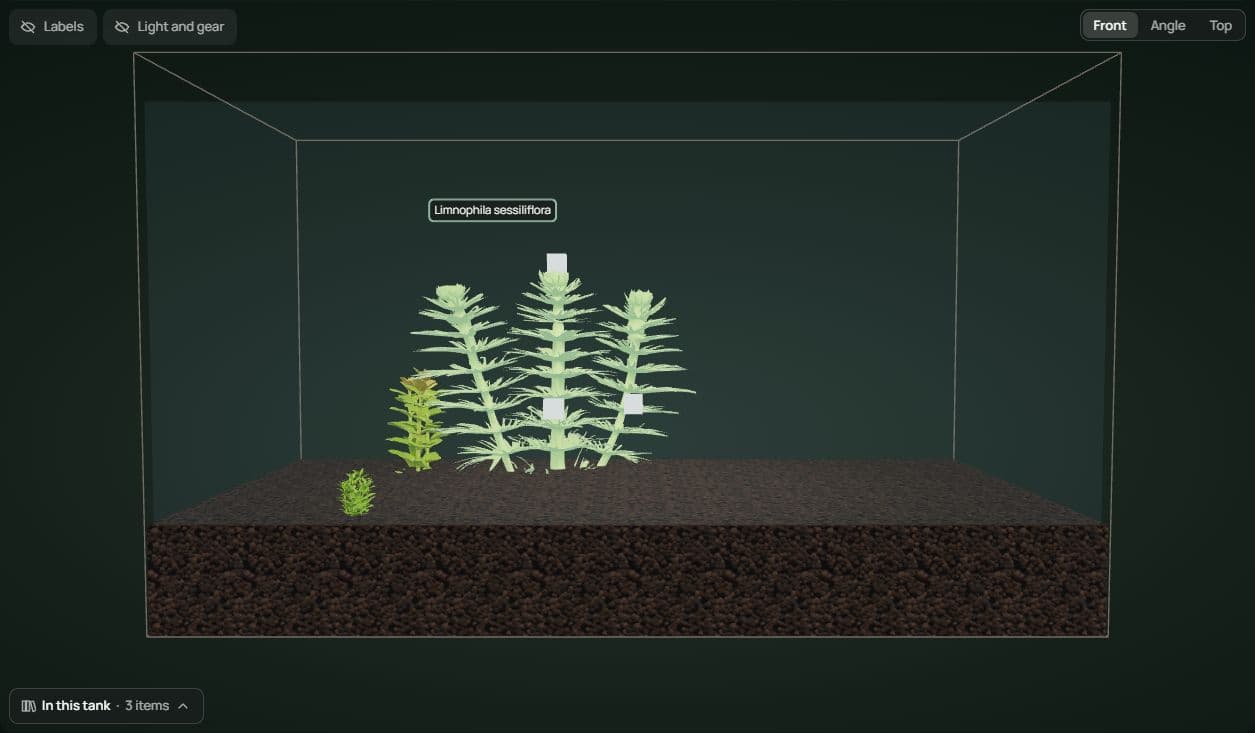
I put three plant models in a 60P and moved only the tallest group. With the tall stems at the back, the broad-leaved middle group had a clear outline on its left. Moving the stems forward left the low plant visible but obscured much of the middle group. If you've planned a Dutch-style street, check that middle layer before ordering more plants or widening the foreground.
The gap I was trying to preserve
The three models were Staurogyne repens, Bacopa caroliniana and Limnophila sessiliflora. The Staurogyne represented the low foreground, the Bacopa gave the middle layer a distinct broad leaf, and the Limnophila supplied a fine-leaved background. I set the Limnophila model to 12 cm long, 23 cm high and 8 cm deep for the comparison. That height was an input I chose, so it tells you nothing about how tall the plant will grow under your light.
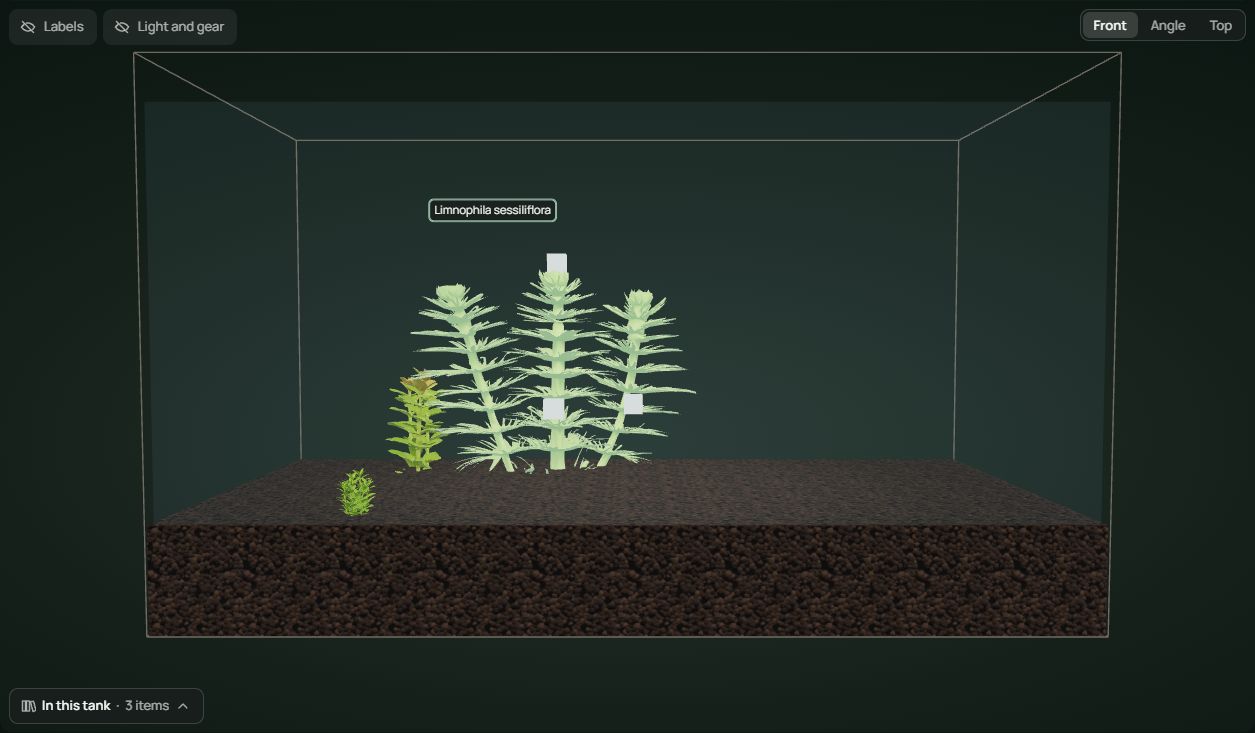
Tall stems at the back. The Bacopa's left edge reads as its own group.
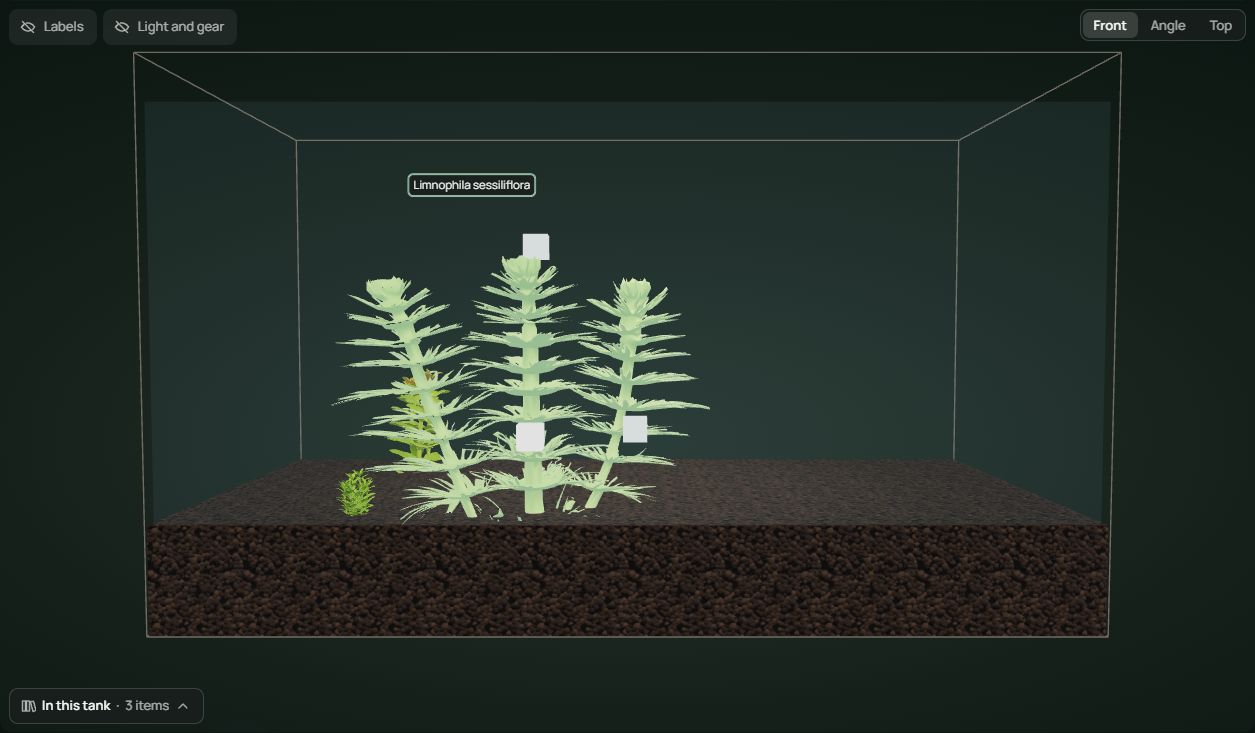
Tall stems at the front. The Staurogyne is still visible on the left, but the middle group is harder to distinguish.
These views are a placement check with three plant models. They aren't a planted aquarium, a growth forecast, or a finished competition entry.
Tall group position | What stayed visible | What became harder to read |
|---|---|---|
Back | The low foreground and the Bacopa’s left outline | No additional overlap in this comparison |
Front | The low Staurogyne on the left | Much of the broad-leaved middle group |
Repeat the two positions
Open the 60P preset in Scapesome Plan. Add Staurogyne repens, Bacopa caroliniana and Limnophila sessiliflora as three distinct groups.
Use Front and keep the low and middle groups fixed. Select the Limnophila and set its length, height and depth to 12 × 23 × 8 cm.
Choose Back in the selected plant’s Position controls and capture the front view. Then choose Front and capture the same view again.
Trace the visible edge of the Bacopa in each image. Compare that edge before changing the width, size or side-to-side placement of any group.
A model’s dimensions describe the space assigned to that group in this plan. They give you a repeatable silhouette to move. To carry the idea into a planted aquarium, sketch the intended group boundaries and compare them again after a real trim.
Use the street to lead to a plant, not a blank gap
In a Dutch-style arrangement, a low band of plants can lead the eye into the tank. The front should make it easy to see where that band begins. Let it narrow as it recedes, with a distinct group giving the eye somewhere to arrive. Draw that route on a top view, then return to the front view to see how much of it remains visible. The three-model comparison here examines only the separation between low, middle and tall groups.
The useful observation from the comparison is where the layers separate. I would leave the tall stems farther back in this arrangement, then use the broad-leaved group to mark one edge of the band. If moving the tall group back still leaves the middle group unreadable, change their sideways overlap before adding another color. A red plant can make the blocked shape brighter without making the group any easier to see.
Rehearse the cut from the seat you usually look from
Draw one low patch, one middle patch and one taller patch. Label the route you will use to reach each with scissors. If the only route to the middle group goes through the low band, widen the working side or move the middle group forward. After the first trim, compare a photo from the same viewing position. Look for the edges you originally intended to keep visible.
Keep a front-view photo after the trim and another when the groups start to overlap again. Use the Bacopa’s edge as the reference in both. If it disappears quickly, decide whether you want to shorten the tall group, narrow its front edge or move the middle group. Make one of those changes first so the next photo tells you which adjustment helped.
A Dutch-style layout asks you to maintain differences between groups. Start with plants whose growing conditions and trimming needs suit your tank, then use the stem plant spacing guide for the planting work. If you are entering a competition, consult the specific AGA judging guidelines rather than treating the three-model exercise as a rules checklist.
Placement comparison recorded in Scapesome Plan on November 9, 2026.
Related reading
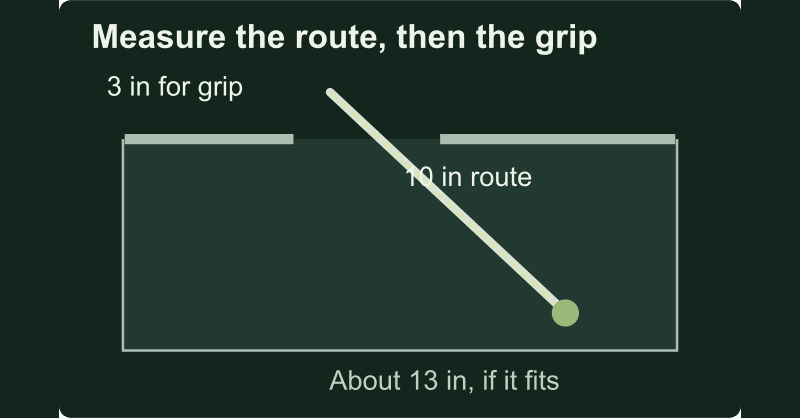
Aquascaping Tools: Check the Reach Before Buying a Kit
Choose tweezers, scissors and a spatula around the jobs in your tank. Compare real tool lengths with your planting route before buying a kit.
Aquarium Plant Fertilizer: Choose the Formula, Then Scale the Dose
Compare root capsules and two liquid formulas, then scale a stated label dose to a 51.3 L water estimate for a mixed planted aquarium.
Aquarium Light for Plants: Check the Fit and the Leaf Distance
Measure the mount and fixture-to-leaf distance. Use one manufacturer’s fit and PAR table to decide what to check before buying a planted-tank light.