Neocaridina Substrate: Should You Use Sand or Aquasoil?
For a new cherry shrimp tank, a verified inert sand or fine gravel is a sensible starting point when your source water already suits the shrimp you intend to buy. An active soil earns its place when you have deliberately chosen its water effects and can maintain that setup. Check the shrimp's identity and the water plan before choosing a bag labelled for shrimp.
Take three facts to the shop
Write down the species, your source-water measurements, and the conditions in the seller's tank. Cherry shrimp usually means a Neocaridina davidi colour strain. A Crystal Red bee shrimp belongs to a different care discussion. Colour and a picture on the bag give you too little information to choose the substrate.
Ask the breeder or shop for the actual pH, GH and KH they maintain. Record GH in °dGH and KH in °dKH, or use the test's stated mg/L as CaCO₃ units consistently for both sets of readings. Keep the instructions with your notes and convert through the test's own chart before comparing different scales.
Then test the water you will use for water changes, prepared as you normally intend to use it. Record the source and any treatment. For purchased reverse-osmosis water, include the remineraliser and its directions. You need a repeatable replacement-water recipe as well as a measurement of the aquarium today.
What the substrate will change
An inert material gives you a floor and planting anchor while leaving the mineral and pH plan to your water supply and any deliberate water preparation. Verify that property for the exact product. Crushed coral, shells and some limestone gravels also sit on a shop's substrate shelf and can change water conditions.
Active soils are sold partly for their effects on the water. For example, Dennerle describes Shrimp King Active Soil as a product for soft, slightly acidic conditions, particularly bee shrimp. Its published pH and KH figures depend on the starting water. Fluval likewise describes Stratum as supporting a neutral to slightly acidic pH and reducing carbonate hardness.
Those effects can be welcome in the setup they were chosen for. Before using the same material for Neocaridina, ask how your replacement water and the soil will behave together. A product name containing “shrimp” cannot answer that question for every shrimp species.
If you already own active soil, read its current instructions before opening another bag. Find its preparation routine, expected water effects and any start-up testing requirements. Keep that information beside your source-water readings. A nutrient-rich planting medium deserves the same scrutiny as a bag marketed specifically for shrimp.
Read the numbers before choosing the bag
As a general reference, Aquarium Co-Op's cherry shrimp guide gives pH 6.5–8.5, GH of at least 6° and KH of at least 2°. A breeder may maintain a successful colony under different conditions. Use published guidance to spot a missing part of your water plan, then compare the actual colony you intend to buy.
Here is a worked decision card. Every measurement and seller target below is hypothetical. The shrimp are assumed to be Neocaridina davidi, and the water readings refer to prepared replacement water. pH has no unit. Both hardness readings use degrees throughout.
Prepared replacement water | Assumed seller's colony | Material being considered | Decision from these inputs |
|---|---|---|---|
pH 7.2, GH 8 °dGH, KH 4 °dKH | pH 7.0–7.5, GH 7–9 °dGH, KH 3–5 °dKH | Verified inert aquarium sand | This water already falls within the assumed colony conditions. Choose the inert route and check the completed tank before introducing shrimp. |
pH reading unstable, GH 1 °dGH, KH 0 °dKH | Same colony as above | A pH-lowering active soil | Establish a mineral and replacement-water plan first. The soil's stated acidifying effect does not supply the GH/KH recipe this example needs. |
Water recipe, GH/KH units or seller conditions unknown | Measurements incomplete | Any substrate | Complete the missing measurements and identify the colony before making a chemistry-based purchase. |
The first row gives a direct reason to choose sand or fine gravel. There is no identified need for a soil to lower this water's pH or KH. You can now choose the grain, colour and plant-feeding approach while preserving the water plan.
The second row needs work before either bag is useful. Prepare replacement water with a shrimp-appropriate remineraliser according to its label, measure both GH and KH, and check the prepared result against your intended colony conditions. Some mineral products raise GH alone, while others raise GH and KH. Read those labels as carefully as the substrate label. Dennerle's GH/KH+ instructions, for example, explicitly target prepared low-mineral water. A different target may require a different product.
Active soil is worth further evaluation when you deliberately need its declared water effects for the plants and the particular colony's established conditions. Record the seller's soil, water recipe and measured conditions, then follow your chosen product's start-up directions in the unstocked tank. Measure whether that combination stays suitable through a normal water-change cycle. This gives you a way to evaluate the active route before committing animals to it.
If you already have a stable colony on active soil, use its actual history when deciding whether to change anything. For a new build, keep the proposed water recipe and substrate working toward the same measured conditions.
Give plants their own feeding plan
Choosing inert material still leaves room for a planted shrimp tank. Attached plants can sit on wood and stone with their rhizomes exposed. Rooted plants need an appropriate feeding approach in the bed. Check the plant, fertiliser and substrate directions together, including any livestock guidance on the product label.
Sketch the rooted area separately from the open feeding area. A large soil bed may be worthwhile for a dense planting plan, but a few attached ferns do not require one to hold them in place. Our aquasoil and sand comparison covers that planting decision in more detail.
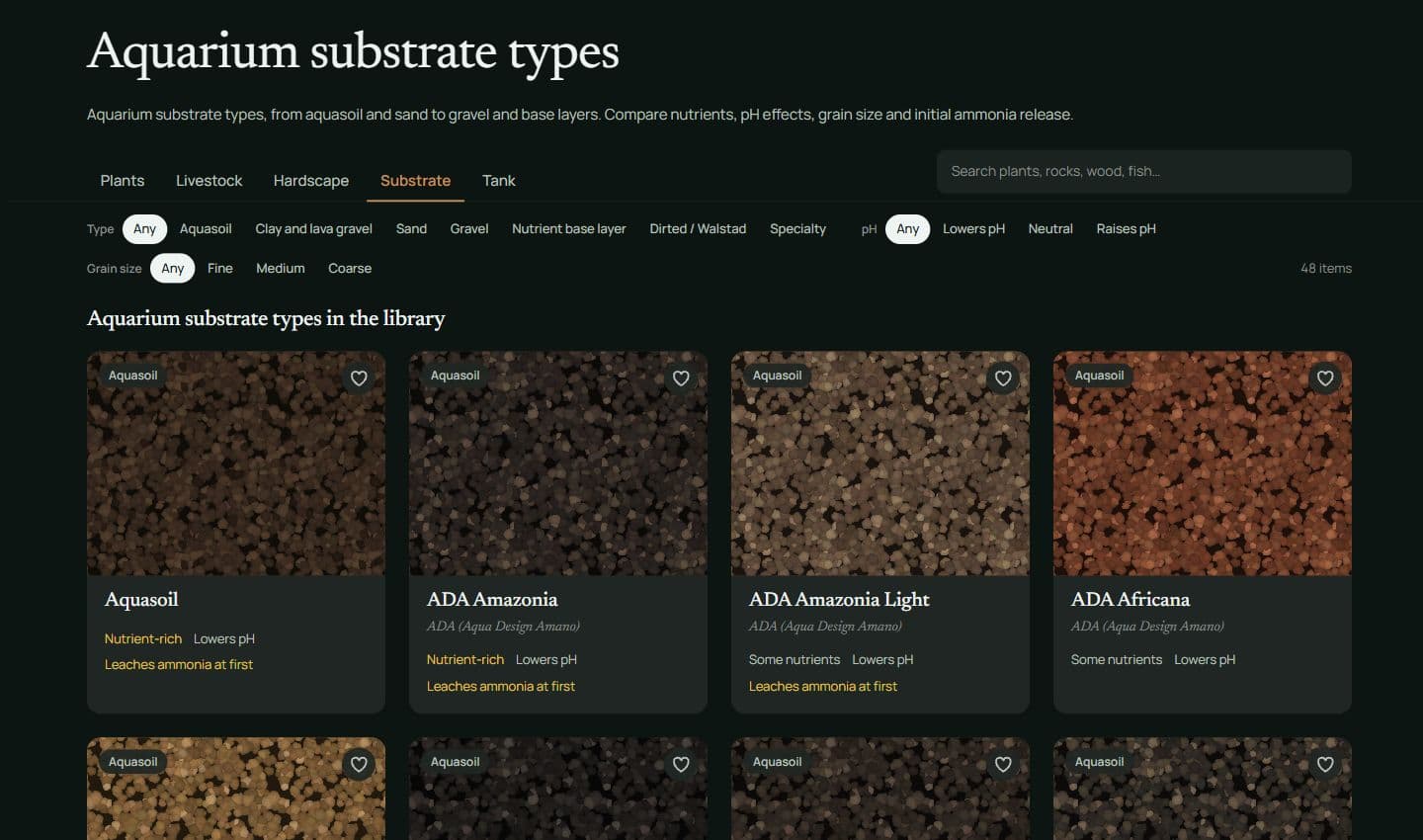
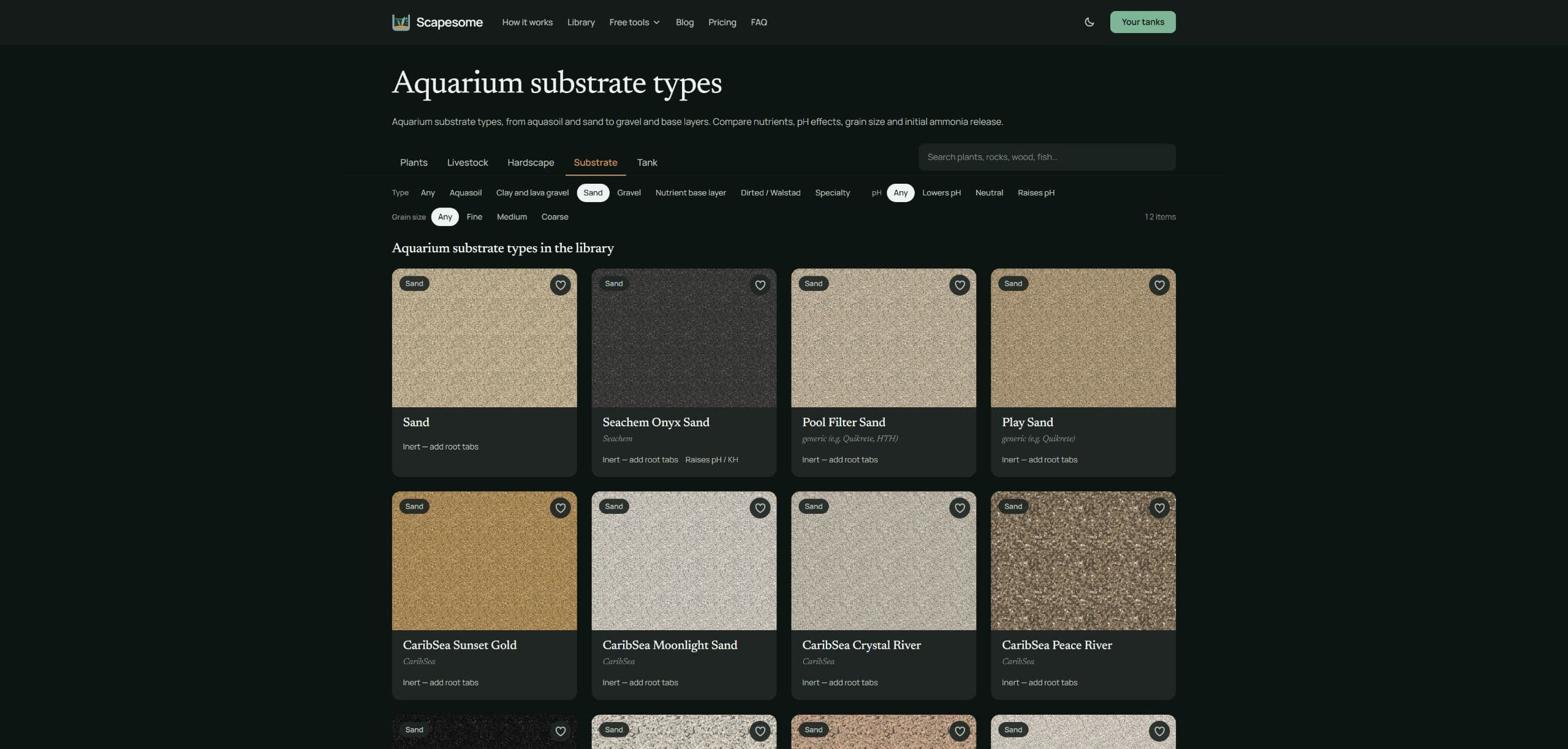
Compare the exact candidates in the substrate library, keeping the manufacturer's instructions handy. The rendered material previews help you inspect the shortlist. Use the written properties and your water plan to decide what belongs in the tank.
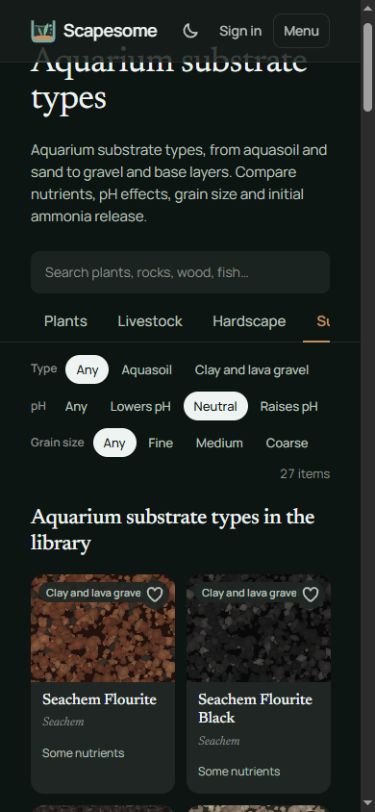
Scapesome substrate library, captured 16 November 2026. The Neutral filter returns 27 items, with Seachem Flourite and Flourite Black visible. Check the exact product's written properties and manufacturer guidance against your water plan.
Estimate the quantity after choosing the material
Here is a simple buying example for a rectangular bed. A 45 × 30 cm footprint filled evenly to an assumed 3 cm depth uses 45 × 30 × 3 ÷ 1,000 = 4.05 L. The depth is an example for the arithmetic. Your plant and substrate instructions determine the bed you actually build.
Use the aquarium substrate calculator to compare your own dimensions and profile. The current one-decimal display rounds this example to 4.1 L. With Sand selected at its default 1.52 kg/L bulk density, the estimated weight displays as 6.2 kg. Check the density for the exact product you will buy, and account for space occupied by buried hardscape or supports.
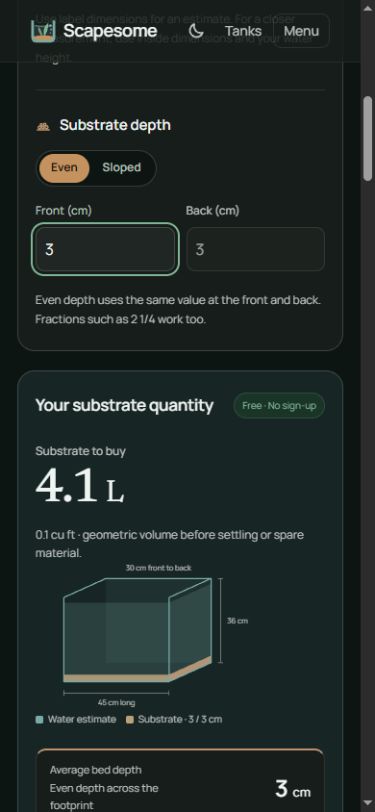
Scapesome substrate calculator, captured 13 November 2026. The 45 × 30 cm footprint and even 3 cm bed display as 4.1 L. The exact geometric calculation is 4.05 L.
That 4.05 L figure tells you about a geometric volume. Obtain water-condition predictions from appropriate product guidance and actual testing. A larger amount of active material does not come with a reliable pH result simply because its volume has been calculated.
Before the shrimp arrive
Build and establish the aquarium, follow the substrate's start-up routine, and check biological filtration with appropriate water testing. Aqueon's freshwater shrimp care sheet recommends an established aquarium because it offers more stable conditions and natural grazing surfaces. The date you poured the substrate cannot establish readiness by itself.
Keep an open patch where you can observe feeding and reach leftovers, protect the filter intake for small shrimp, and check any fish companions for predation risk. The planted-tank stocking checks help you carry those questions into the rest of the plan.
Take your measured water, the exact substrate name and the seller's colony conditions back to the decision. For many first cherry shrimp setups, this points toward a verified inert floor with a separate plant-feeding plan. If you choose active soil, you should be able to explain the water conditions it is helping you maintain and how you will check them.
Care and product guidance checked November 2026 — cherry shrimp water conditions · active-soil water effects.
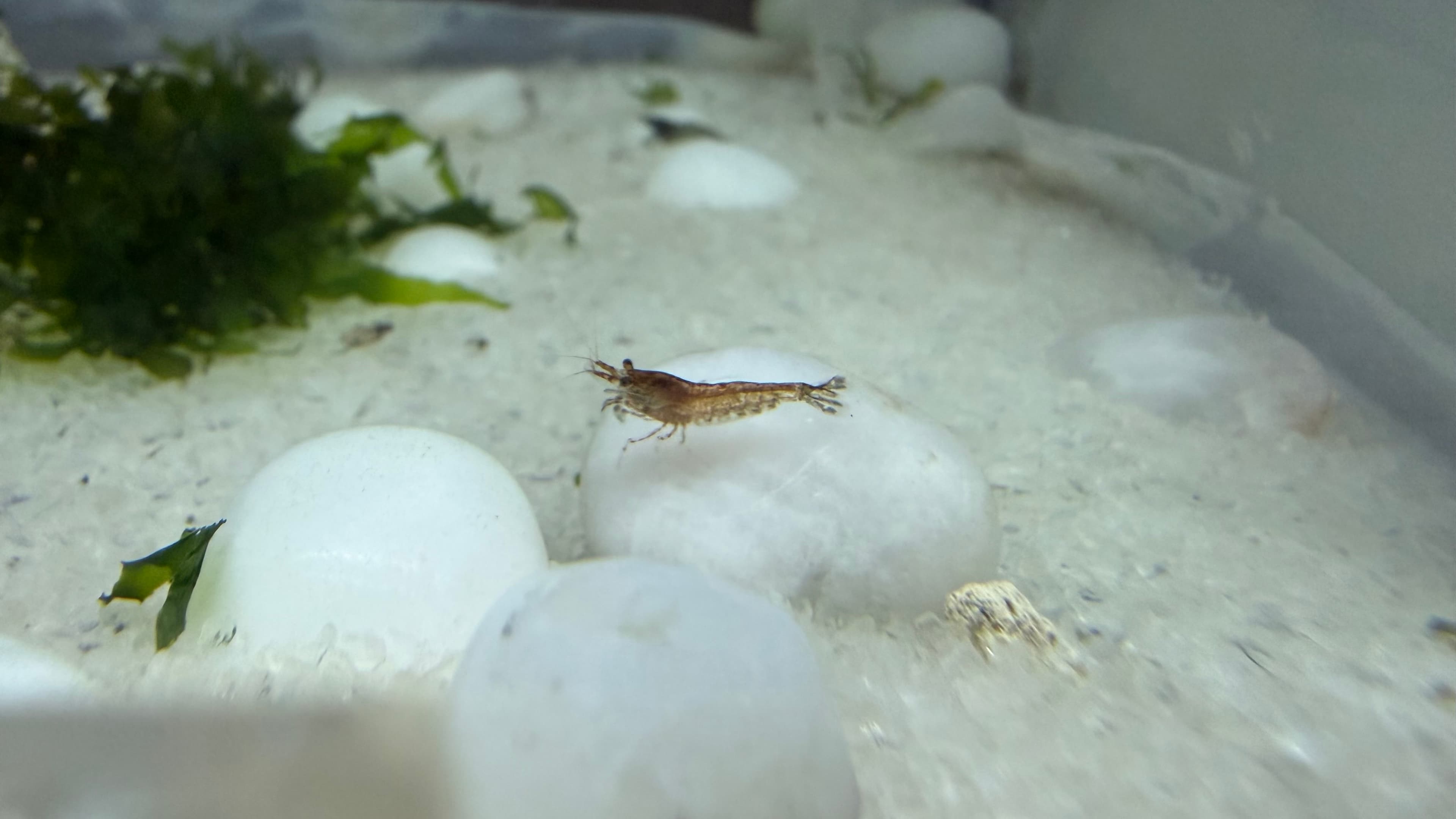
Cover photograph of Neocaridina davidi by UnknownM123, CC0 1.0.

Related reading
Aquarium Substrate Depth: Plan the Bed, Then Buy the Bags
Plan flat or sloped substrate, split sand and aquasoil into separate zones, then estimate liters, weight and bags using the material’s density.
Aquasoil vs sand: which does your planted tank need?
Choose a bottom layer for the roots, water conditions and open areas in your plan. Learn when sand can work and what aquasoil needs you to check.
Can aquarium plants grow in sand? What to plant and how
Work out which plants belong in the sand, which belong on hardscape, and how their nutrient and anchoring needs differ.